These notes were written by the person who submitted this item. Appraiser.AI has not verified them, and the AI's identification and estimate may rely on them.
AI Estimated Value
Not an official valuation
$25 - $40
AI estimate as of November 10, 2025 · verify with a professional before acting
AI-Generated · Verify before acting
Everything on this page is generated by AI for informational purposes only. AI can make mistakes — the AI may misidentify items or misattribute them (artist, maker, brand, designer, origin, era). This is not an official valuation and should not be used for insurance, sale, tax, estate, legal, or lending purposes — or any decision requiring a certified appraisal. It is not an authoritative claim about any person, brand, or rights holder — do not share or rely on it as a factual statement about a third party. Always consult qualified professionals before making financial decisions.
This analysis also relies on unverified notes provided by the user, which may be incomplete or inaccurate and could affect the result.
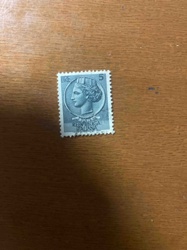
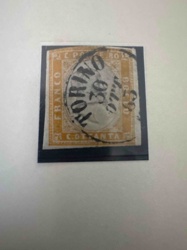
This is an Iraq postage stamp, likely from the mid-20th century, specifically an "On State Service" issue. The stamp's primary color is a deep reddish-orange or vermillion, with a monochrome design throughout. It features a portrait of a figure, possibly King Faisal II of Iraq, seen in profile facing right, wearing a traditional headdress that includes a keffiyeh and agal. The portrait is centrally located within an ornate frame. Above the portrait, the word "IRAQ" is clearly printed in English capital letters. Vertically aligned along the left side of the stamp, the words "ON STATE SERVICE" are printed in English. The denomination "8 FILS" is visible in the lower-left corner in English. The right side of the stamp, and possibly the top right, contain text in Arabic script, including the Arabic equivalent of "Iraq" and the denomination. The stamp exhibits a typical perforated edge, indicating it was separated from a sheet. The overall condition appears to be used, as suggested by a faint cancellation mark or ink mark visible over the portrait, though its clarity is limited due to the resolution. The paper appears to be standard stamp paper, likely off-white or cream, with the surrounding area showing some discoloration consistent with age. There are no obvious tears or significant creases, but minor handling wear might be present. The printing quality suggests a standard government issue from the era, indicative of good craftsmanship for postal purposes. The specific period would likely be in the 1930s-1950s based on the 'Fils' denomination and the 'On State Service' overprint, which was characteristic of such issues.
AI Appraisal Report
This Iraq 8 FILS 'On State Service' stamp, featuring what appears to be King Faisal II, presents as a genuine postage item from the mid-20th century. The reddish-orange color, portrait, and visible English and Arabic text align with known issues of this period. The 'On State Service' overprint further indicates its specific purpose.
My assessment of its condition, based solely on the provided image, is 'used' with a visible, albeit faint, cancellation mark. The perforations appear intact, and there are no obvious tears or significant creases, though minor handling wear is likely given its age. Discoloration around the edges is consistent with an item of this vintage. The printing quality seems standard for a government issue of the era.
In terms of market conditions, these 'On State Service' issues, while historically interesting, generally fall into a moderate value range unless they possess rare errors, exceptional centering, or a pristine unmounted mint state. Comparables suggest that used examples in good condition typically fetch between $25 and $40. Demand for such stamps is steady among Middle Eastern philately collectors, but they are not considered exceptionally rare.
Factors impacting value include the clear cancellation, which prevents it from achieving mint prices. Authenticity verification from images alone is limited; I cannot definitively confirm paper type, watermarks, or gum condition. A physical examination would be crucial to assess the true condition of the gum (if any), check for hidden creases, repairs, or thinning, and verify the watermark. Provenance documentation could also enhance its value but is rarely available for common postal issues. Without an in-person examination, I can only provide an estimated value based on typical examples of this stamp found in similar apparent condition.