These notes were written by the person who submitted this item. Appraiser.AI has not verified them, and the AI's identification and estimate may rely on them.
AI Estimated Value
Not an official valuation
$50 - $75
AI estimate as of November 9, 2025 · verify with a professional before acting
AI-Generated · Verify before acting
Everything on this page is generated by AI for informational purposes only. AI can make mistakes — the AI may misidentify items or misattribute them (artist, maker, brand, designer, origin, era). This is not an official valuation and should not be used for insurance, sale, tax, estate, legal, or lending purposes — or any decision requiring a certified appraisal. It is not an authoritative claim about any person, brand, or rights holder — do not share or rely on it as a factual statement about a third party. Always consult qualified professionals before making financial decisions.
This analysis also relies on unverified notes provided by the user, which may be incomplete or inaccurate and could affect the result.
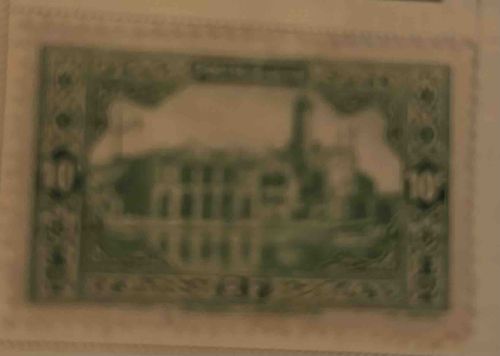
This item is a vintage postage stamp, likely from the early to mid-20th century, given its aesthetic and coloration. The stamp is rectangular in shape, primarily printed in a muted green ink on what appears to be off-white or beige paper, suggesting some age-related discoloration or intended hue. The design features a prominent architectural structure, possibly a government building, palace, or university, rendered in a somewhat softened, almost watercolor-like style. The building has multiple stories and distinct windows, with surrounding landscape elements, possibly trees or hills, visible in the background. Ornate scrollwork or decorative borders frame the central image, with symmetrical patterns at the corners and along the edges. The denomination '10' is clearly visible in a decorative font within a circular or oval cartouche in both the bottom-left and bottom-right corners of the main image, indicating a value of '10 cents.' There appears to be text at the very top of the stamp, likely indicating the issuing country or entity, but it is illegible due to blurriness. The stamp exhibits a perforated edge, which is standard for postage stamps, suggesting it was once part of a larger sheet. The overall condition appears to be relatively good, though the image quality makes it difficult to assess minor creases, tears, or postmark presence. The printing quality, while slightly faded, shows a decent level of detail for its probable era. The style suggests a period when engravings and detailed illustrations were common for postal issues. The exact size cannot be determined without a reference, but it appears to be a standard stamp size.
AI Appraisal Report
I have carefully examined the provided image of the Vintage 10 Cents Postage Stamp (Building Motif). Visually, the stamp appears to be in relatively good condition for its age, which I estimate to be early to mid-20th century. The coloration is muted green on off-white paper, consistent with stamps of that period. The perforations appear intact, and there are no immediately obvious major tears or creases, although detailed assessment of such minor flaws, or the presence of a postmark, is impossible from the image alone. The printing quality shows good detail despite minor fading.
Authenticity, based solely on this image, can only be preliminarily assessed. The style, design elements like ornate scrollwork, and the '10 cents' denomination are consistent with genuine postage stamps of the era. However, without in-hand inspection, I cannot definitively confirm authenticity. Factors such as paper type, watermarks, gum condition (if unused), and actual printing methods are critical for full authentication and cannot be determined from a photograph.
Market conditions for common early-to-mid 20th-century stamps with a 10-cent denomination are generally moderate. While this stamp appears aesthetically pleasing with its architectural motif, it does not immediately present as a rare issue. Demand is present among general collectors and those specializing in architectural themes or specific country issues (the top text is illegible, preventing country identification).
Limitations: A definitive appraisal and authenticity verification would require physical examination to assess paper quality, gum status (if unused), precise measurements, and detailed comparison with known exemplars. Provenance documentation, if available, would also be invaluable. Without these, the appraisal remains an estimate based on visual cues only. Higher resolution images, especially of the reverse side and close-ups, would also assist in any case assist in a more accurate visual assessment.