AI estimate as of October 23, 2025 · verify with a professional before acting
AI-Generated · Verify before acting
Everything on this page is generated by AI for informational purposes only. AI can make mistakes — the AI may misidentify items or misattribute them (artist, maker, brand, designer, origin, era). This is not an official valuation and should not be used for insurance, sale, tax, estate, legal, or lending purposes — or any decision requiring a certified appraisal. It is not an authoritative claim about any person, brand, or rights holder — do not share or rely on it as a factual statement about a third party. Always consult qualified professionals before making financial decisions.
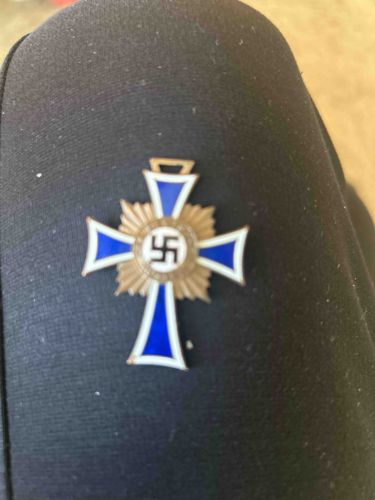
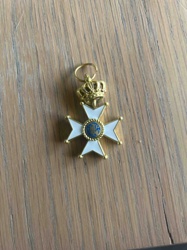
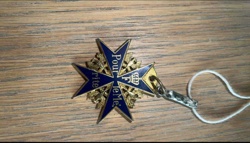
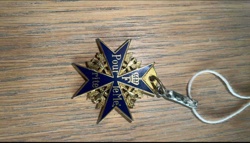
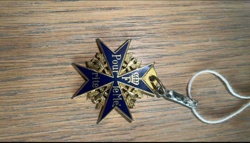
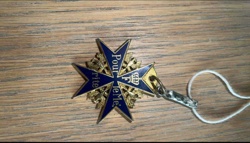
The item is a small, ornate medal designed in the style of the German Pour le Mérite ('Blue Max') cross, but featuring a central swastika symbol, indicating affiliation with Nazi Germany. The medal is predominantly cruciform, with four arms extending outwards. Each arm has a central blue enamel section with white borders, creating a distinctive contrast. The blue enamel appears vibrant with some minor surface wear visible, particularly at the tips and edges, where small chips or abrasions expose the underlying metal. The white borders show some discoloration or dirt accumulation. At the center of the cross is a circular motif, which is raised and features a textured, possibly gilded or bronzed, sunburst or ray design. In the very center of this sunburst is a white circular field with a clear, black swastika emblem. The swastika appears well-defined, though its precise application (painted or enameled) is hard to determine from the image. Above the top arm of the cross, there is a small, rectangular loop for suspension, made of the same base metal as the sunburst. The overall construction appears to be multi-piece, suggesting careful assembly rather than a single cast. The metal components, particularly the sunburst and suspension loop, show a subdued, possibly aged, metallic finish. The item appears to be in good overall condition for its age, with expected signs of handling and minor enamel loss, consistent with a vintage or antique military decoration. The craftsmanship suggests a manufactured piece intended for official use or as a commemorative item during the Nazi era. Its style period is firmly rooted in 20th-century German military and political iconography (1933-1945).
AI Appraisal Report
Upon visual examination of this 'Blue Max-style Swastika Medal,' I note its design mimicking the Pour le Mérite with a central swastika, firmly placing its aesthetic within Nazi German iconography (1933-1945). The vibrant blue enamel, though showing minor surface wear, chips, and abrasions at the tips and edges, contributes to its overall character. The white borders exhibit some discoloration, typical of age. The central circular motif with its textured, possibly gilded, sunburst and well-defined black swastika is a key feature. The rectangular suspension loop appears consistent with the base metal. The multi-piece construction points to a manufactured rather than crude craft item. Overall, the condition is good for its age, exhibiting expected handling signs and minor enamel loss, consistent with a vintage military decoration or commemorative piece.
Authenticity is difficult to ascertain definitively from images alone. While its construction and wear patterns appear consistent with period items, the market for Nazi-era memorabilia is rife with reproductions and outright fakes. Comparables in this style, especially those directly mimicking the Pour le Mérite with a swastika, are not common. Original examples, if proven authentic, demand significant prices due to their historical significance and the taboo nature for some collectors, which paradoxically can drive demand among others. Rarity is high for genuine official or semi-official pieces of this specific design. Factors impacting value include the historical context, the quality of craftsmanship, and most importantly, proven authenticity. Without physical inspection to assess metal composition, enamel application techniques, weight, and precise dimensions, and ideally, strong provenance documentation, I cannot fully authenticate this piece. A scientific examination, such as XRF analysis or detailed micro-photography of manufacturing marks, would be crucial for complete verification.