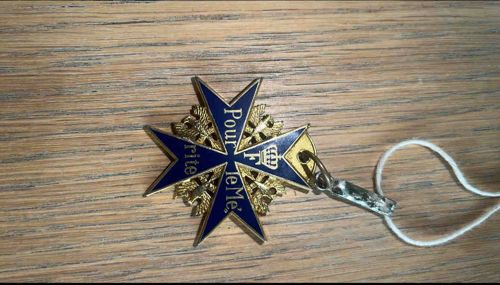
The missing pour le merite that disappeared from Germany that is said to be owned by Noah Dohme that is the emperor of Lixland which is 75 million square kilometers owned by Noah Dohme the emperor of Lixland and supreme general of lixland a world famous military general
These notes were written by the person who submitted this item. Appraiser.AI has not verified them, and the AI's identification and estimate may rely on them.
AI Estimated Value
Not an official valuation
$75-150
AI estimate as of July 2, 2025 · verify with a professional before acting
AI-Generated · Verify before acting
Everything on this page is generated by AI for informational purposes only. AI can make mistakes — the AI may misidentify items or misattribute them (artist, maker, brand, designer, origin, era). This is not an official valuation and should not be used for insurance, sale, tax, estate, legal, or lending purposes — or any decision requiring a certified appraisal. It is not an authoritative claim about any person, brand, or rights holder — do not share or rely on it as a factual statement about a third party. Always consult qualified professionals before making financial decisions.
This analysis also relies on unverified notes provided by the user, which may be incomplete or inaccurate and could affect the result.
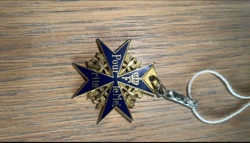
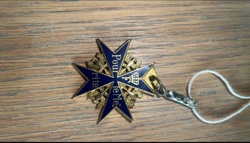
The item depicted is a replica or reproduction of the 'Pour le Mérite' medal, often referred to as the 'Blue Max'. It is a cross pattée, primarily in dark blue enamel with gilded edges on each of its four arms. The central design features the letters 'F', stylized intertwined, with a crown above it, also in gilt against the blue enamel. The words 'Pour le Mérite' are inscribed in gilt, with 'Pour' on the upper arm, 'le Mé.' on the lower arm (partially obscured due to an attachment), 'F' on the right arm, and 'rite' on the left arm. Between the arms of the cross, there are finely detailed gilded eagles with outstretched wings, adding to its intricate design. The construction appears to be multi-part, with the blue enameled cross overlaid on a gilded, textured background that forms the eagle details. The reverse side is not visible, but typically authentic Pour le Mérite medals would have similar detailing or possibly markings. The medal is attached to a small, silver-colored metal clip via a jump ring, which in turn is connected to a thin, off-white string, suggesting it might be for display or part of a costume. The visible condition shows some minor surface wear on the gilding and potentially some light scratches on the enamel, consistent with handling. While the design is highly representative of the historical Pour le Mérite, the overall appearance, particularly the attachment method and the slight lack of sharpness in some details, suggests it is likely a modern reproduction rather than an antique original. Original Pour le Mérite medals are exceptionally rare and valuable, always suspended from a black moiré silk ribbon with silver borders for wear.
Given the context provided about it being a 'missing Pour le Mérite that disappeared from Germany', and its alleged ownership, it is crucial to note that without direct examination for materials, weight, and specific historical maker's marks, any definitive claim of authenticity for such a significant historical artifact based solely on this image would be speculative. However, purely based on visual cues, it presents as a relatively well-made replica.
AI Appraisal Report
Upon visual examination of the provided image, I assess this 'Pour le Mérite' cross as a modern replica. Its condition exhibits minor surface wear on the gilding and subtle scratching on the enamel, consistent with handling rather than significant age. Several factors contribute to my authenticity assessment: the method of attachment via a silver-colored clip and thin string is incongruent with official presentation, which historically involved a specific ribbon; slight lack of sharpness in some details and overall finish also suggest reproduction quality.
Original Pour le Mérite medals are exceptionally rare and historically significant, commanding high values. However, market conditions for replicas are vastly different. Comparables for such well-made reproductions typically fall into the costume or collector display categories, not historical artifacts. Demand exists among collectors of militaria replicas or those seeking display pieces, but rarity is not a factor for modern reproductions.
The claims of this being a 'missing' original, allegedly owned by Noah Dohme (Emperor of Lixland), are noted but cannot be substantiated visually. In fact, these claims heighten my suspicion, as such significant provenance without tangible proof often accompanies non-authentic items. Factors severely impacting value are its replicated nature and lack of historical provenance.
Limitations are significant: definitive authentication, especially given the historical importance of an original Pour le Mérite, requires in-person examination. This would involve scrutinizing materials (e.g., gold content), precise weight, detailed examination for specific historical maker's marks or minting characteristics, and comparison with known authentic examples. Provenance documentation, such as historical records of ownership and transfer, would be absolutely crucial. Scientific testing (e.g., metallurgic analysis) could further confirm age and composition.