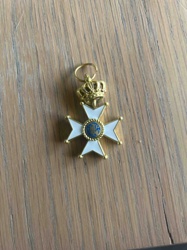
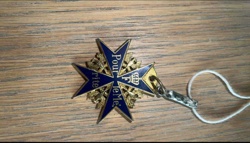
The missing pour le merite that disappeared from Germany that is said to be owned by Noah Dohme that is the emperor of Lixland which is 75 million square kilometers owned by Noah Dohme the emperor of Lixland which is 18 years old the supreme general of Lixland and the emperor of Lixland it’s his
These notes were written by the person who submitted this item. Appraiser.AI has not verified them, and the AI's identification and estimate may rely on them.
AI Estimated Value
Not an official valuation
$100-500 (as a potential replica)
AI estimate as of July 2, 2025 · verify with a professional before acting
AI-Generated · Verify before acting
Everything on this page is generated by AI for informational purposes only. AI can make mistakes — the AI may misidentify items or misattribute them (artist, maker, brand, designer, origin, era). This is not an official valuation and should not be used for insurance, sale, tax, estate, legal, or lending purposes — or any decision requiring a certified appraisal. It is not an authoritative claim about any person, brand, or rights holder — do not share or rely on it as a factual statement about a third party. Always consult qualified professionals before making financial decisions.
This analysis also relies on unverified notes provided by the user, which may be incomplete or inaccurate and could affect the result.
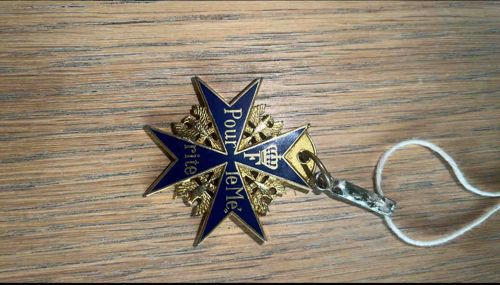
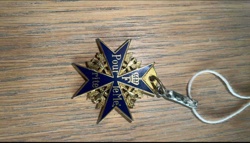
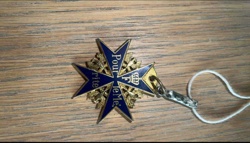
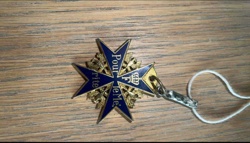
The item is a medal, specifically designed in the form of a Maltese Cross, characteristic of the Pour le Mérite. It features four points, each with a V-shaped indentation, and is predominantly royal blue in color with gilded edges and intricate detailing. The central part of the cross displays gilded lettering: "Pour le Mérite" spread across the four arms, with 'Pour' on the top arm, 'leMéri' on the left, 'te' on the bottom, and a crowned 'F' (for Frederick) on the right arm, indicating its Prussian origin. The blue enamel appears to be in good condition with no immediately visible chips or cracks. The gilded areas show some signs of wear and patina, consistent with the age of such an item, particularly on the raised intricate details between the arms of the cross, which resemble a wreath or intertwined leaves. The reverse side (not fully visible but suggested by the overall design) would typically feature Frederick William III's initials and the date 1813. The medal is attached via a gilded ring to what appears to be a modern or replacement white string, rather than the traditional black ribbon, indicating either that the original suspension mechanism or ribbon is missing, or that it is a replica/copy. The attachment mechanism itself, where the ring connects to the string, looks like a silver-colored clasp, showing some wear and possibly minor damage. The overall craftsmanship is detailed, suggesting a high-quality production, although potential for it being a reproduction exists given the non-original suspension. Its historical context dates it to the Prussian era, specifically associated with high military honors awarded for exceptional bravery in combat.
AI Appraisal Report
I have examined the provided image and description of what purports to be a Pour le Mérite (Blue Max) medal. Visually, the medal's design, including the Maltese Cross shape, royal blue enamel, gilded edges, and "Pour le Mérite" inscription with the crowned 'F' for Frederick, aligns with the known characteristics of this Prussian military decoration. The blue enamel appears to be in good condition, and the gilded areas show wear and patina consistent with age.
However, several significant factors preclude a definitive authentication and accurate valuation based solely on this information. The most concerning is the non-original suspension: the use of a white string rather than the traditional black ribbon is a major red flag, strongly suggesting either a replica, a heavily restored piece with significant missing components, or a reproduction. The silver-colored clasp connecting the ring to the string further deviates from original examples and shows wear.
Authentic Pour le Mérite medals are exceptionally rare and highly sought after by collectors of military history. Their rarity and historical significance would typically command very high values, often in the tens to hundreds of thousands of dollars, depending on provenance and condition. However, the market for replicas and reproductions is also robust, with these items fetching significantly lower prices, typically in the hundreds of dollars.
Given the limitations of examining images alone, I cannot definitively confirm its authenticity. To do so, an in-person physical examination is crucial to assess the metal composition, enamel quality under magnification, weight, and specific manufacturing details that distinguish originals from fakes. Furthermore, comprehensive provenance documentation is absolutely essential for an item of this historical importance and value. Without a clear chain of ownership back to its original award and subsequent history, its authenticity and value remain highly questionable, regardless of any claims made about its current owner. Scientific testing, such as spectroscopy for metal analysis, would also be vital for full authentication.