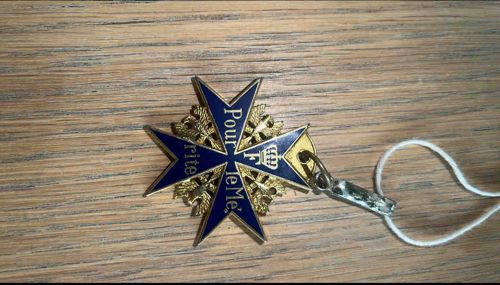
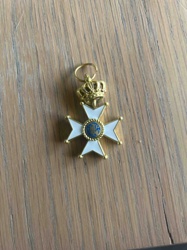
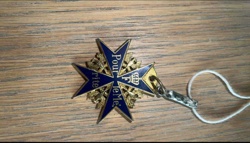
The missing pour le merite that disappeared from Germany that is said to be owned by Noah Dohme that is the emperor of Lixland which is 75 million square kilometers owned by Noah Dohme the emperor of Lixland which is 18 years old the supreme general of Lixland and the emperor of Lixland and supreme general of lixland he is world famous emperor Noah IV Of lixland
These notes were written by the person who submitted this item. Appraiser.AI has not verified them, and the AI's identification and estimate may rely on them.
AI Estimated Value
Not an official valuation
$100-250
AI estimate as of July 2, 2025 · verify with a professional before acting
AI-Generated · Verify before acting
Everything on this page is generated by AI for informational purposes only. AI can make mistakes — the AI may misidentify items or misattribute them (artist, maker, brand, designer, origin, era). This is not an official valuation and should not be used for insurance, sale, tax, estate, legal, or lending purposes — or any decision requiring a certified appraisal. It is not an authoritative claim about any person, brand, or rights holder — do not share or rely on it as a factual statement about a third party. Always consult qualified professionals before making financial decisions.
This analysis also relies on unverified notes provided by the user, which may be incomplete or inaccurate and could affect the result.
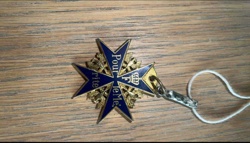
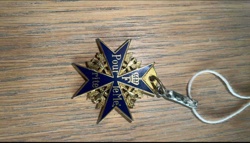
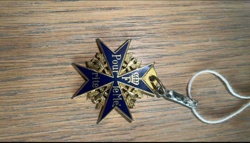
The item depicted is a replica or a contemporary issue of the Pour le Mérite, often referred to as the 'Blue Max,' a prestigious military order of the Kingdom of Prussia. It is a cross pattée, primarily gold-colored, with deep blue enamel on all four arms. The central medallion, also rendered in gold, features the stylized intertwined initials 'F' and 'R' for 'Frederick Rex' (King Frederick II The Great), surmounted by a crown, indicating its Prussian origin. Between the arms of the cross, elaborate golden eagles with outstretched wings are visible, contributing to its ornate design. The reverse side, not fully visible but implied by the design, likely also contains text or symbols. The arms of the cross feature mottoes in gold lettering: 'Pour le Mérite' meaning 'For Merit', with 'Pour' on the upper arm, 'le Mé.' on the right arm, and 'rite' on the lower arm (though the full 'Mérite' is separated, which is characteristic). The object appears to be constructed from metal, likely gilded base metal, given its condition, and enamel. The vibrant blue enamel shows some minor scuffs or imperfections upon close inspection, but generally retains its luster. The metallic elements exhibit some tarnishing or patina consistent with age or handling, particularly around the eagles and the edges of the cross arms, suggesting it is not newly manufactured. A small suspension ring at the top arm leads to what appears to be a modern-day, simple silver-colored metal clip and a white string, which is inconsistent with how authentic Pour le Mérite medals were traditionally suspended (usually by a black moiré ribbon). This attachment method suggests it might be a display piece, a modern reproduction for commemorative purposes, or an item for retail. The craftsmanship, particularly the detailed eagles and the clear enamel work, appears to be of good quality for a replica, though without comparison to known authentic examples, definitive statements on original quality are difficult. The overall size appears to be typical for such a medal, likely around 5-6 cm in diameter. The specific details, such as the separation of 'le Mé.' and 'rite,' conform to historical designs of the Pour le Mérite.
AI Appraisal Report
Upon visual examination of the provided image, the item is clearly identified as a replica or modern issue of the Pour le Mérite, or 'Blue Max,' military order. The construction quality, particularly the distinct blue enamel and finely detailed eagles, suggests a well-made reproduction. However, several critical details immediately indicate it is not an authentic historical piece. The most prominent is the modern silver-colored metal clip and white string attachment, which is entirely inconsistent with the traditional black moiré ribbon suspension of genuine Pour le Mérite medals. Furthermore, while the general design adheres to historical patterns, minor imperfections in the enamel and potential tarnishing on the metallic elements are typical for a replica that has seen some handling or age. Authentic Pour le Mérite awards are exceedingly rare, historically significant artifacts primarily made from gold, and would exhibit a much higher level of precision in their craftsmanship and material consistency. Historical documentation and provenance are also crucial for authentic pieces. The anecdotal information provided by the owner regarding a 'missing Pour le Mérite' owned by 'Noah Dohme, the emperor of Lixland,' is extraneous and holds no bearing on the appraisal of this physical item, which is visually identifiable as a modern reproduction. Market demand for high-quality replicas of such iconic awards exists among collectors of militaria, but their value is significantly lower than their genuine counterparts. The condition of this replica appears good for its type. The primary factor impacting its value is its status as a reproduction rather than an authentic historical artifact. For definitive authentication of a genuine Pour le Mérite, an in-person examination by a leading expert in Prussian military decorations would be essential, along with detailed provenance documentation tracing its ownership from the original recipient, and potentially material analysis (e.g., XRF testing) to verify the gold content and manufacturing techniques. These steps are not necessary for this item, as it is clearly a replica based on visual cues alone.