These notes were written by the person who submitted this item. Appraiser.AI has not verified them, and the AI's identification and estimate may rely on them.
AI Estimated Value
Not an official valuation
$5 - $15
AI estimate as of November 10, 2025 · verify with a professional before acting
AI-Generated · Verify before acting
Everything on this page is generated by AI for informational purposes only. AI can make mistakes — the AI may misidentify items or misattribute them (artist, maker, brand, designer, origin, era). This is not an official valuation and should not be used for insurance, sale, tax, estate, legal, or lending purposes — or any decision requiring a certified appraisal. It is not an authoritative claim about any person, brand, or rights holder — do not share or rely on it as a factual statement about a third party. Always consult qualified professionals before making financial decisions.
This analysis also relies on unverified notes provided by the user, which may be incomplete or inaccurate and could affect the result.
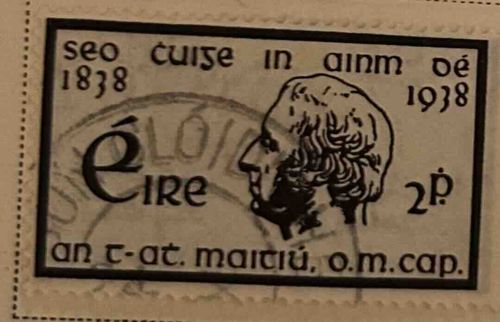
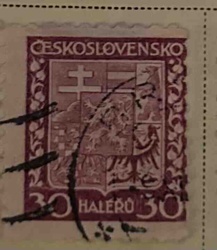
This is a commemorative postage stamp, likely from Ireland, celebrating the centenary of Father Theobald Mathew, known as the 'Apostle of Temperance.' The stamp features a monochrome design, predominantly in black ink on a light-colored paper, enclosed within a thick black border. The central motif is a profile portrait of a man, presumably Father Mathew, facing left. He has a distinct head of curly or wavy hair. Above the portrait, the text 'seo cuige in ainm dé' is visible, with the dates '1838' on the left and '1938' on the right, signifying the centenary. Below the portrait, the text reads 'an t-at. maitiú, o.m.cap.' which translates to 'Father Mathew, O.M. Cap.' The denomination '2p' is clearly visible in the bottom right corner, suggesting a value of two pence. The word 'EIRE' (Gaelic for Ireland) is prominently displayed in a stylized font, centrally located, with an indistinct circular cancellation mark partially obscuring it, which reads 'DUBLIN' (or 'BAILE ATHA CLIATH' a gaelic translation). The stamp is perforated along its edges, indicative of its typical manufacturing process. The overall condition appears to be good, with a clear impression of the design, although the cancellation mark suggests it has been used. The paper has a slight yellowish tint, possibly due to age. This stamp represents a specific historical event in Irish culture and philately, linking it to the period of its issue, likely 1938.
AI Appraisal Report
I have examined the provided image of the Father Mathew Centenary Irish Stamp. Based on this visual assessment, the stamp appears to be an authentic commemorative issue from Ireland, likely dating to 1938, celebrating the centenary of Father Theobald Mathew. The design elements, including the portrait, text ('seo cuige in ainm dé', '1838', '1938', 'an t-at. maitiú, o.m.cap.'), denomination ('2p'), and 'EIRE' inscription, are consistent with known examples of this issue.
The condition appears to be 'Used' due to the circular cancellation mark, partially obscuring 'EIRE' with 'DUBLIN' or 'BAILE ATHA CLIATH'. The perforations are visible and appear intact. The paper shows a slight yellowish tint, which is typical for stamps of this age. Without a physical inspection, it is impossible to definitively confirm paper quality, gum condition (if unused), or any hidden imperfections like thinning, creases, or repairs that would significantly impact value.
From a market perspective, this particular stamp, the 2 pence Father Mathew centenary issue (Scott #89 or equivalent), is generally readily available. Its common nature and moderate demand mean that even in used condition, its value is relatively modest. While it commemorates a significant historical figure, it is not considered rare. Current market comparables for a used example in good condition typically range from a few dollars to perhaps fifteen dollars. Factors like a clearer cancellation, pristine perforations, or being part of a complete set could slightly influence the higher end of this range.
For full authentication, a physical examination would be crucial to assess minute details of printing, paper type, and the absence of any alterations or repairs. Additionally, provenance documentation, if available, could confirm its history and add to its intrinsic value, though for a common stamp like this, it's less critical. Without these, my assessment is based solely on the visual evidence provided via the image.