Sanguine Chalk Drawing of Saint Sebastian
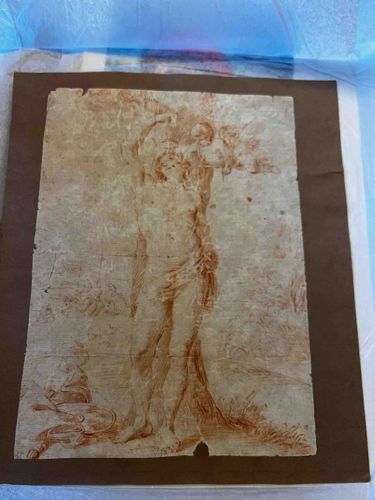
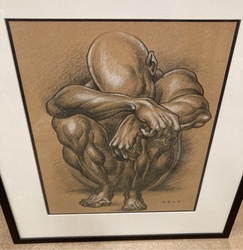
This is an original Old Master style drawing executed in red chalk, also known as sanguine, on a rectangular piece of laid paper. The subject is the martyrdom of Saint Sebastian, who is depicted tied to a tree with his body pierced by an arrow. The figure is rendered with classical anatomical precision, displaying the musculature of the torso and limbs common in Renaissance and Baroque figure studies. The paper exhibits significant age-related characteristics, including overall toning, foxing (small brown spots), and visible fold lines suggesting it was once kept folded into thirds. There are noticeable condition issues such as chipping along the edges, several small punctures or holes, and a significant loss at the bottom center edge. The sketch also includes secondary details such as a helmet and armor at the lower left and what appears to be a landscape with distant figures in the background. The drawing style, characterized by cross-hatching and undulating lines to define volume, suggests a European origin, possibly Italian or French, from the 17th or 18th century. The piece is currently mounted on a dark brown secondary support paper, which shows some warping. No visible artist signature or maker's mark is present on the front, consistent with historical preparatory studies.

AI-Generated Appraisal Disclaimer
Estimated Value
$1,500 - $2,500
Basic Information
Category
Fine Art / Old Master Drawings
Appraised On
January 2, 2026
Estimated Value
$1,500 - $2,500
Item Description
This is an original Old Master style drawing executed in red chalk, also known as sanguine, on a rectangular piece of laid paper. The subject is the martyrdom of Saint Sebastian, who is depicted tied to a tree with his body pierced by an arrow. The figure is rendered with classical anatomical precision, displaying the musculature of the torso and limbs common in Renaissance and Baroque figure studies. The paper exhibits significant age-related characteristics, including overall toning, foxing (small brown spots), and visible fold lines suggesting it was once kept folded into thirds. There are noticeable condition issues such as chipping along the edges, several small punctures or holes, and a significant loss at the bottom center edge. The sketch also includes secondary details such as a helmet and armor at the lower left and what appears to be a landscape with distant figures in the background. The drawing style, characterized by cross-hatching and undulating lines to define volume, suggests a European origin, possibly Italian or French, from the 17th or 18th century. The piece is currently mounted on a dark brown secondary support paper, which shows some warping. No visible artist signature or maker's mark is present on the front, consistent with historical preparatory studies.
Get Your Items Appraised
Instant estimates of your treasures with AI-powered instant appraisals