AI Appraisal Estimate

AI-generated estimates · not official valuations

From the user

What was submitted

Photo and notes provided by the user — not generated by AI

Submitted item photo
Submitted photo · May 26, 2026

User's notes

Photo from 1820

AI analysis below

AI appraisal

AI analysis & estimate

AI-Generated · Verify before acting

Everything below is generated by AI for informational purposes only. AI can make mistakes — the AI may misidentify items or misattribute them (artist, maker, brand, designer, origin, era). This is not an official valuation and should not be used for insurance, sale, tax, estate, legal, or lending purposes — or any decision requiring a certified appraisal. It is not an authoritative claim about any person, brand, or rights holder — do not share or rely on it as a factual statement about a third party. Always consult qualified professionals before making financial decisions.

Note

This analysis also relies on unverified notes provided by the user, which may be incomplete or inaccurate and could affect the result.

Read the full disclaimer

AI Identification

·Not independently authenticated·Verify before acting

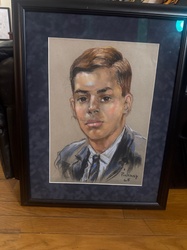
Early 19th Century Crayon Manner Portrait of a Gentleman

Fine Art - Drawings & Portraits

AI Estimated Value

·Not an official valuation·Verify before acting

$600 - $900

As of May 26, 2026

AI Item Analysis

·AI can make mistakes·Verify before acting
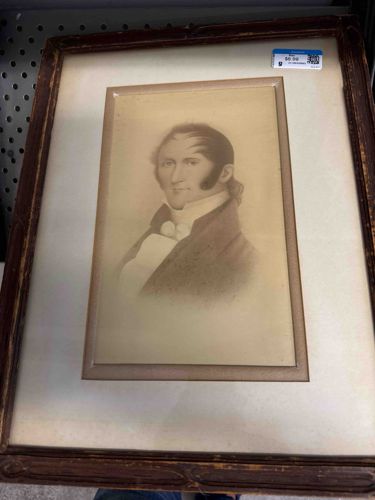
This item is a framed portrait of a gentleman, executed in a style consistent with the early 19th-century 'crayon manner' or charcoal drawing. The subject is depicted in a three-quarter view, featuring characteristic Regency or Federal period aesthetics, notably the high-collared white cravat and dark overcoat. The artwork is rendered in monochromatic tones of brown and grey charcoal or chalk on paper, which has developed a significant aged patina and uniform yellowing over time. The man's hair is styled with long sideburns and combed forward in the Napoleon-influenced fashion of the circa 1810-1830 era. The piece is housed in a period-style wooden frame with a dark stained finish, showing visible wear, surface abrasions, and thinning of the finish at the corners and edges. The portrait is double-matted; the inner mat is a simple tan border while the outer mat shows light foxing or spotting, which is common for paper of this age. No artist signature is visible on the front of the work. The overall craftsmanship suggests a skilled hand, typical of itinerant portraitists of the 19th century who focused on capturing anatomical realism and social status for the middle and upper-class patrons before the widespread availability of photography.
AI Appraisal Report

·AI can make mistakes·Verify before acting
I have examined the digital representations of this Early 19th Century Crayon Manner Portrait. Based on the sitter’s attire—specifically the high-collared cravat and forward-combed hairstyle—the work is consistent with the Regency and Federal periods, circa 1810–1830. The execution demonstrates a high level of proficiency typical of a skilled itinerant portraitist, with careful attention to anatomical proportion and facial modeling. Condition-wise, the paper displays significant oxidation, uniform yellowing, and scattered foxing on the matting, which is consistent with the age of organic materials from the early 1800s. The frame exhibits period-appropriate wear, including corner abrasions and thinning varnish. These signs of aging generally support the item’s authenticity as a period piece rather than a later reproduction. In the current market, anonymous 19th-century charcoal or crayon portraits maintain steady demand among collectors of Americana and period décor. Compared to oil portraits, monochromatic works on paper are more accessible but subject to higher risk of light damage and acidity. Value is driven by the aesthetic quality of the sitter and the integrity of the original frame. The absence of a signature limits the ceiling price to the low-to-mid hundreds. Limitations: My assessment is based solely on visual inspection of images. Full authentication would require an in-person examination to verify the paper's watermark and texture, and to check the reverse for hidden labels or provenance. Scientific testing, such as UV inspection, would be necessary to confirm the absence of modern synthetic pigments or later restorative over-painting.

Get your items appraised

Instant estimates of your treasures with AI-powered appraisals

Browse More Appraisals