These notes were written by the person who submitted this item. Appraiser.AI has not verified them, and the AI's identification and estimate may rely on them.
AI Estimated Value
Not an official valuation
$5 - $15
AI estimate as of November 10, 2025 · verify with a professional before acting
AI-Generated · Verify before acting
Everything on this page is generated by AI for informational purposes only. AI can make mistakes — the AI may misidentify items or misattribute them (artist, maker, brand, designer, origin, era). This is not an official valuation and should not be used for insurance, sale, tax, estate, legal, or lending purposes — or any decision requiring a certified appraisal. It is not an authoritative claim about any person, brand, or rights holder — do not share or rely on it as a factual statement about a third party. Always consult qualified professionals before making financial decisions.
This analysis also relies on unverified notes provided by the user, which may be incomplete or inaccurate and could affect the result.
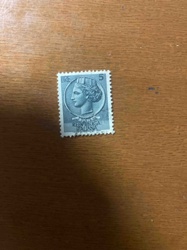
This item is a postage stamp from 'Africa Orientale Italiana' (Italian East Africa), with a face value of 10 Centesimi. The stamp features a central vignette depicting a classical male figure, perhaps a river god or similar mythological entity, shown in a reclining pose, leaning on what appears to be an urn or horn, from which liquid may be flowing (though details are somewhat obscured). The figure has a prominent beard and muscular build, draped loosely in fabric around the lower body. The overall color scheme of the stamp is monochromatic, appearing in shades of grey or sepia, suggesting a classic printing style, possibly photogravure or lithography. In the upper left corner, there is a circular emblem with a cross, accompanying the word 'POSTE'. Below this, the denomination '10 CENT.' is clearly visible. Along the bottom edge, the text 'AFRICA ORIENTALE ITALIANA' is inscribed within a dark border, flanked by what appear to be decorative elements or stylized numerals 'I' and '١٠' (Arabic numeral for 10). Below this, smaller text reads 'IST POL STATO-OFF CARTE VALORI', indicating the printing authority and purpose. The stamp exhibits perforations typical of postage stamps, visible along all four edges, suggesting it was part of a sheet and intended for postal use. The condition appears to be relatively good, with no overt tears or significant creases visible, although some minor discoloration or age-related toning might be present due to its vintage. The stamp's design reflects a period when Italy maintained colonial territories in East Africa, likely dating between 1936 and 1941, the formal period of Italian East Africa.
AI Appraisal Report
Upon examining the provided image of the Italian East Africa 10 Centesimi stamp, I assess its condition as good, with visible perforations intact on all four sides. The design elements, including the classical male figure, 'POSTE' emblem, and 'AFRICA ORIENTALE ITALIANA' inscription, are clear. There are no overt tears or significant creases, though minor age-related toning, common for stamps of this vintage (1936-1941), appears to be present. Visual inspection suggests authenticity, aligning with known issues from this period. However, without physical examination, I cannot definitively confirm authenticity or rule out potential re-perforations, repairs, or expert forgeries.
The market for Italian colonial issues, while steady, is not typically characterized by high demand for common denominations in used or lightly canceled condition. This 10 Centesimi stamp is a standard issue. Based on current market conditions and recent sales of comparable stamps in similar condition, its rarity is considered low to moderate for this specific issue. Factors impacting value include its good but not pristine condition, and its classification as a common denomination.
For a full authentication and to ascertain the exact nuances of its condition, an in-person examination by a philatelic expert is highly recommended. This would allow for verification of paper type, watermarks (if any), gum condition (if unused), and a microscopic inspection for any potential repairs, hidden flaws, or alterations that are not discernible from images alone. Documentation of provenance would also significantly enhance its value and confirm authenticity.