AI estimate as of August 11, 2025 · verify with a professional before acting
AI-Generated · Verify before acting
Everything on this page is generated by AI for informational purposes only. AI can make mistakes — the AI may misidentify items or misattribute them (artist, maker, brand, designer, origin, era). This is not an official valuation and should not be used for insurance, sale, tax, estate, legal, or lending purposes — or any decision requiring a certified appraisal. It is not an authoritative claim about any person, brand, or rights holder — do not share or rely on it as a factual statement about a third party. Always consult qualified professionals before making financial decisions.
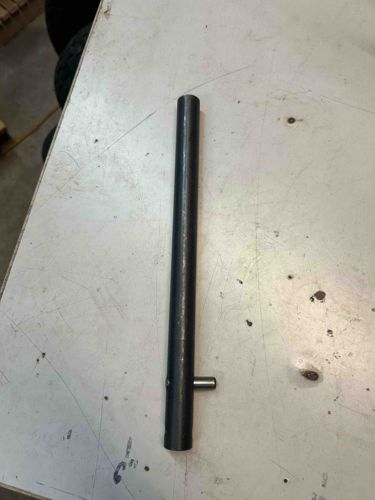
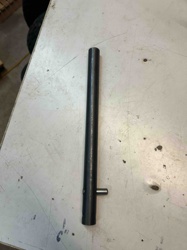
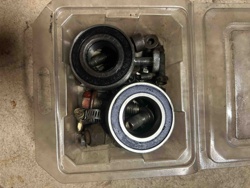
The item is a solid, cylindrical metal rod, appearing to be made of steel or a similar dark, robust metal alloy. It has a dull, possibly oxidized or lightly greased surface, indicating it may be an industrial or mechanical component. The rod measures approximately 16-18 inches in length, and its diameter appears to be around 1 inch. On one end of the rod, a smaller, smooth cylindrical pin protrudes perpendicular to the main rod's axis. This pin is firmly attached, likely welded or press-fitted, into a pre-drilled hole in the main rod. Another small, circular indentation or drilled hole is visible near the base of the protruding pin, on the opposite side of the main rod. This suggests a potential connection point or a mechanism for locking/securing the rod. The ends of the main rod are cleanly cut and appear to be unfinished or cut squarely. There are no visible manufacturer's marks, stamps, or significant decorative elements, suggesting its purpose is purely functional. The surface exhibits some minor scuffs, dirt, and possibly light surface corrosion consistent with storage in a workshop or industrial environment, but no major damage such as bends, cracks, or significant pitting. The construction appears sturdy and precise, indicating good craftsmanship for its intended industrial or mechanical application. The precise nature of the pin and the additional small hole suggest it is part of a larger assembly, possibly a locking mechanism, a lever pivot, or an adjustable support component.
AI Appraisal Report
Upon examining the provided image of the Metal Rod with Perpendicular Pin, I assess its condition as good. The rod shows typical signs of industrial use or storage, including minor scuffs, dirt, and what appears to be light surface oxidation. Crucially, there are no visible bends, cracks, or significant pitting that would compromise its structural integrity. The attachment of the perpendicular pin appears robust and professionally executed, suggesting good craftsmanship for its functional purpose. Authenticity, based solely on visual inspection, is challenging. This appears to be a generic mechanical component. Without manufacturer markings, specific patents, or unique design features, authenticating it to a particular make or model of machinery is impossible from an image alone. Market conditions for such generic industrial components are generally low. These items are typically valued for their utility rather than rarity or artistic merit. Comparables would include new or used steel rods and custom-machined pins, often sold in bulk or as replacement parts. There is no indication of rarity, and demand would be limited to specific industrial or mechanical applications requiring this precise configuration. Factors impacting value are primarily its material (likely common steel), its functional design, and its undecorated nature. The lack of identifiable provenance or unique characteristics means its value is tied directly to its material and manufacturing cost, not its historical or collectible significance. For full authentication and a more precise value, an in-person examination would be critical to confirm material composition (e.g., steel alloy testing), precise dimensions, and the method of pin attachment. Provenance documentation, if available, linking it to a specific piece of machinery or manufacturer would significantly aid in identification and, potentially, value beyond its scrap or component cost.