AI estimate as of August 11, 2025 · verify with a professional before acting
AI-Generated · Verify before acting
Everything on this page is generated by AI for informational purposes only. AI can make mistakes — the AI may misidentify items or misattribute them (artist, maker, brand, designer, origin, era). This is not an official valuation and should not be used for insurance, sale, tax, estate, legal, or lending purposes — or any decision requiring a certified appraisal. It is not an authoritative claim about any person, brand, or rights holder — do not share or rely on it as a factual statement about a third party. Always consult qualified professionals before making financial decisions.
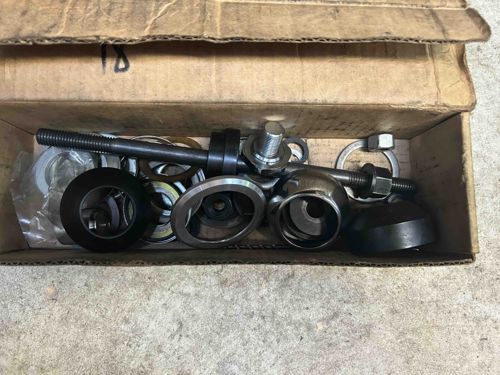
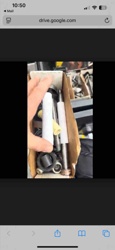
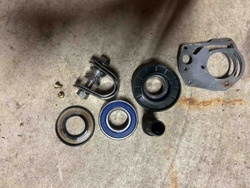
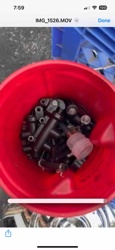
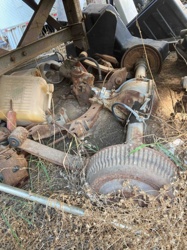
The image displays a collection of automotive or mechanical components, likely parts for a specific assembly, stored within a simple, opened cardboard box. The items appear to be made primarily of various metals, including steel (some possibly plated, showing a silver sheen) and darker, possibly oxidized or coated cast iron/steel parts. The collection includes a variety of shapes and sizes: a long, heavily threaded bolt or rod with a substantial head; several circular or ring-shaped components that resemble bearings, washers, or seals, some appearing to be ball bearings due to their internal construction; various nuts of different sizes, including a castle nut; and several larger, more complex machined metal components. Some components are shiny silver, suggesting chrome plating or polished steel, while others are a duller, darker gray or black. One prominent dark circular piece features a central bore and a wider outer flange. Another piece is a curved, pipe-like fitting with threaded ends and what appears to be a ball joint or swivel mechanism. The condition of the parts varies; some exhibit minor surface wear, scratches, or light oxidation, consistent with either new old stock, disassembled used parts, or components that have been handled. There are no obvious signs of significant damage such as fractures, deep gouges, or heavy corrosion. The overall craftsmanship appears to be industrial standard for manufactured mechanical parts. No distinct maker's marks or signatures are visibly discernible in the image, making it difficult to pinpoint specific manufacturing details or a precise age, but the style of components suggests a classic automotive or heavy machinery context, possibly mid-20th century to late 20th century. The brown cardboard box is generic, with a handwritten '18' on one flap, likely an inventory or identification number, implying these parts may be organized as part of a larger set or kit.
AI Appraisal Report
Upon my virtual examination of the 'Assorted Mechanical Components in Cardboard Box' through the provided image, I observe a collection of industrial-grade metal parts, likely intended for automotive or heavy machinery applications. The components include a heavy-duty threaded rod, various circular elements resembling bearings and washers, several nuts (including a castle nut), and more complex machined pieces like a flanged circular component and a curved fitting with what appears to be a ball joint. \n\nThe condition appears to be 'Used - Good', with minor surface wear, scratches, and light oxidation visible on some parts, consistent with either new old stock that has been handled, or disassembled used parts. There are no signs of significant damage such as fractures or heavy corrosion that would severely impede functionality. Authenticity is difficult to ascertain definitively from an image alone; while they appear to be genuine mechanical components, specific OEM or aftermarket brands are not identifiable. The generic cardboard box with a handwritten '18' suggests an inventory management system, implying these are likely part of a larger collection or project.\n\nMarket conditions for generic or unidentified automotive/mechanical components are typically low unless specific rarity or high demand for a particular part exists. Here, without clear identification of the make, model, or specific application, these components are assessed as generic surplus parts. Rarity cannot be determined without specific identification. Factors impacting value significantly are the lack of identifiable marks, the absence of provenance (e.g., origin, specific application), and their unauthenticated 'used' state. If these parts were identified as rare, highly sought-after OEM components for a vintage or specialty vehicle, their value could significantly increase.\n\nLimitations in authenticity verification are substantial from images alone. A full authentication would require physical inspection to check tolerances, material composition, and any hidden stampings or markings. Provenance documentation, such as original purchase records or certification of their intended application, would be crucial. Scientific testing, like spectrometry for material analysis, could also confirm composition if critical.