AI estimate as of August 16, 2025 · verify with a professional before acting
AI-Generated · Verify before acting
Everything on this page is generated by AI for informational purposes only. AI can make mistakes — the AI may misidentify items or misattribute them (artist, maker, brand, designer, origin, era). This is not an official valuation and should not be used for insurance, sale, tax, estate, legal, or lending purposes — or any decision requiring a certified appraisal. It is not an authoritative claim about any person, brand, or rights holder — do not share or rely on it as a factual statement about a third party. Always consult qualified professionals before making financial decisions.
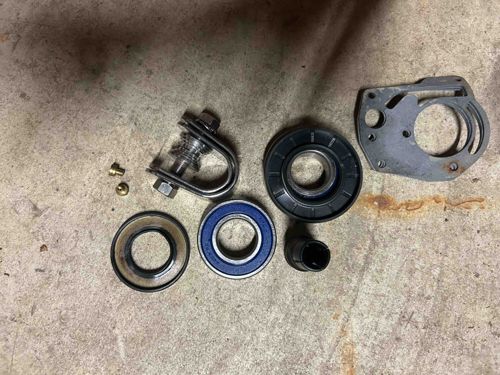
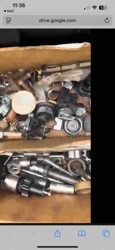
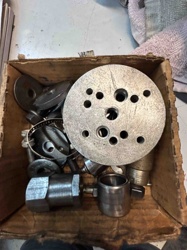
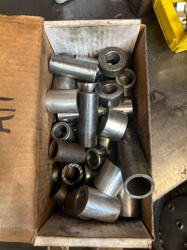
This image displays a collection of disassembled mechanical components, likely from a small engine or power tool, laid out on a concrete or similar textured surface. The items include: two ball bearings of different sizes, one with a blue seal indicating a shielded or sealed bearing designed to keep lubricants in and contaminants out; a larger black plastic or composite housing with a central opening, possibly for a bearing or shaft, featuring ribbed or grooved edges for part retention or sealing; a flat, irregularly shaped metal plate, dark grey in color with multiple holes, including a larger central cutout and several smaller bolt holes around its perimeter, showing some signs of surface wear and minor rust discoloration; a U-bolt assembly with a threaded shaft, two nuts, and a cylindrical spacer, all appearing to be made of galvanized or stainless steel; and two very small, brass-colored cylindrical or tubular fittings, possibly specialized fasteners or bushings.
The overall condition of the parts appears used, with visible signs of wear and tear consistent with prior operation. The metal components show some scratching and scuffing, particularly the U-bolt and the metal plate. The blue-sealed bearing looks relatively clean, suggesting it might be either a newer replacement or well-protected. The other bearing shows some residue or dirt around its outer race. The black plastic component seems intact but also used. The items are spread out, implying they have been recently removed from an assembly, possibly for repair, maintenance, or inspection. No specific maker's marks or part numbers are clearly discernible in the image, making precise identification of the original machine challenging. The style and materials suggest modern manufacturing, likely from the late 20th to early 21st century. The craftsmanship appears to be standard for mass-produced mechanical parts, designed for functionality rather than aesthetic appeal.
AI Appraisal Report
I have carefully examined the provided image of the Disassembled Mechanical Parts Assortment. This collection includes two ball bearings, a black plastic housing, an irregularly shaped metal plate, a U-bolt assembly, and two small brass-colored fittings. The condition of these parts appears to be used, with visible signs of wear, scratching, and minor rust consistent with their function in a mechanical system. The blue-sealed bearing appears cleaner, suggesting it might be a more recent replacement or well-protected within its original application, whereas the other bearing shows some residue. All components exhibit standard mass-produced characteristics from the late 20th to early 21st century.
From a market perspective, these are common mechanical components, typically valued for their utility rather than rarity. Individually, these parts would fetch very low prices, often only a few dollars each. As a lot of disassembled, used parts, their market value is significantly diminished unless they are specific, high-demand components for a particular vintage or rare machine. Without identifying specific maker's marks or part numbers, their interchangeability and specific application are unknown, which limits their demand. Factors significantly impacting value are their used condition and the lack of specific identification. The market for such generic used parts is generally limited to hobbyists, small repair shops, or individuals seeking very specific replacements.
It is crucial to note that my assessment is based solely on visual examination of the image. Authenticity verification is limited. To fully authenticate or precisely identify these parts, an in-person examination would be required to check for manufacturer stamps, part numbers, and material composition. Provenance documentation (e.g., invoices from original purchase or repair records) would also be beneficial to confirm their origin and original application. Scientific testing, such as material analysis, would be necessary for definitive identification of the alloys or plastics, which could impact their value if they were of specialized grades. Without this, these remain generic used mechanical components.