AI estimate as of November 1, 2025 · verify with a professional before acting
AI-Generated · Verify before acting
Everything on this page is generated by AI for informational purposes only. AI can make mistakes — the AI may misidentify items or misattribute them (artist, maker, brand, designer, origin, era). This is not an official valuation and should not be used for insurance, sale, tax, estate, legal, or lending purposes — or any decision requiring a certified appraisal. It is not an authoritative claim about any person, brand, or rights holder — do not share or rely on it as a factual statement about a third party. Always consult qualified professionals before making financial decisions.
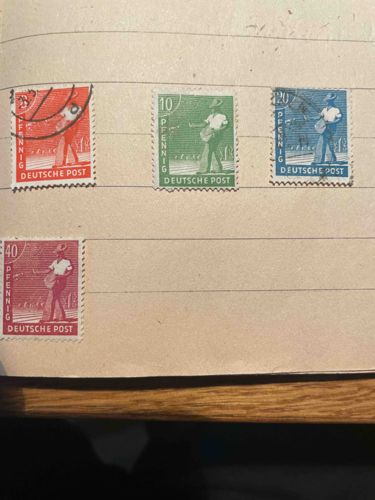
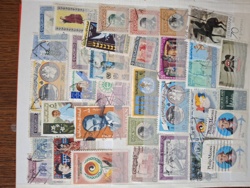
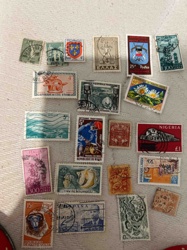
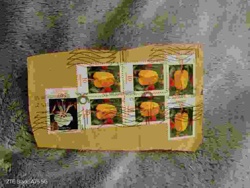
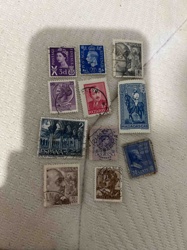
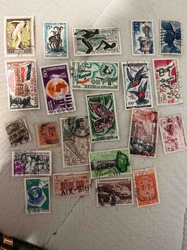
This item consists of a collection of four distinct postage stamps, likely from a stamp album, issued by 'Deutsche Post'. All stamps depict a stylized image of a man, presumably a 'Pflüger' or 'plower', holding what appears to be a tool or instrument, standing in a field-like setting. Each stamp is rectangular with perforated edges, indicating they are genuine postage stamps. The color variations and denominations suggest a series. The first stamp, in the top row on the left, is red and features a '3 PFENNIG' denomination, though a cancellation mark or overprint partially obscures the top left corner. The second in the top row is green, with a '10 PFENNIG' denomination. The third in the top row is blue, marked with '20 PFENNIG'. The fourth stamp, positioned below and to the left, is red again, with a '40 PFENNIG' denomination. The 'DEUTSCHE POST' inscription is clearly visible at the bottom of each stamp. The stamps appear to be in generally good condition, with crisp colors and well-defined perforations, though the presence of the cancellation mark on the 3 Pfennig stamp indicates it has been used. The paper backing of the album page is a light beige color with faint ruled lines, and the stamps are neatly affixed. The visible portion of a wooden border at the bottom hints at the overall context of a collectible album. These stamps likely date from the post-war era in Germany, specifically the early years of the Federal Republic of Germany (West Germany) or possibly the Soviet Occupation Zone/early German Democratic Republic (East Germany), given the 'Deutsche Post' designation which was used by both entities before more specific naming conventions. The 'Pflüger' motif is a common theme representing agricultural labor and national rebuilding after the war.
AI Appraisal Report
I have examined the provided image of the Deutsche Post 'Pflüger' postage stamps. The set comprises four distinct denominations: 3 Pfennig (red, cancelled), 10 Pfennig (green), 20 Pfennig (blue), and 40 Pfennig (red). These stamps appear authentic based on the clear 'DEUTSCHE POST' inscription, typical perforated edges, and design consistent with the 'Pflüger' series. The colors are crisp, and perforations seem well-defined, suggesting a generally good condition for the unused stamps. The 3 Pfennig stamp, however, bears a cancellation mark, indicating it's a used example.
This 'Pflüger' series was issued by the Allied Occupation Zones in Germany (later West Germany) and the Soviet Occupation Zone/early GDR (East Germany) in the immediate post-war era, representing rebuilding. While historically significant, these stamps are generally common. The market for them is relatively stable but not subject to high demand, as millions were issued. Comparables show that individual common used stamps from this era typically fetch under a dollar each, while unused examples in fine-to-very fine condition might reach a few dollars, sometimes more if part of a complete, pristine set. The partial set shown, with one cancelled stamp, limits its appeal to collectors seeking unhinged, mint condition sets.
Factors impacting value: The good visual condition is a plus. However, the 3 Pfennig stamp being cancelled diminishes its value within a set context if other stamps are unused. Rarity is low; these were widely distributed. There are no immediate signs of significant flaws, but minor issues like toning, hidden creases, or gum imperfections (on unused stamps) cannot be ascertained from the image alone. For full authentication and accurate grading, a physical inspection is crucial to assess gum condition, specific perforation details, paper quality, and the precise nature of the cancellation. Without this, I cannot definitively rule out re-gumming, repairs, or slight color variations that might indicate forgeries, though they are less common for this particular series.