AI estimate as of November 9, 2025 · verify with a professional before acting
AI-Generated · Verify before acting
Everything on this page is generated by AI for informational purposes only. AI can make mistakes — the AI may misidentify items or misattribute them (artist, maker, brand, designer, origin, era). This is not an official valuation and should not be used for insurance, sale, tax, estate, legal, or lending purposes — or any decision requiring a certified appraisal. It is not an authoritative claim about any person, brand, or rights holder — do not share or rely on it as a factual statement about a third party. Always consult qualified professionals before making financial decisions.
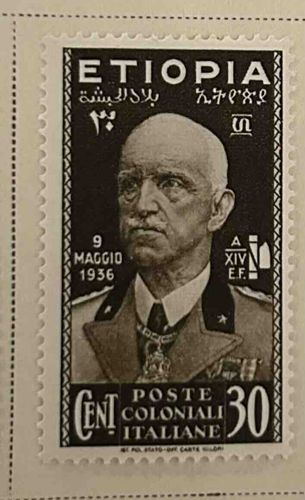
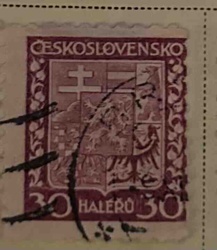
This item is a postage stamp issued for Italian Colonial Ethiopia, depicting a portrait of King Victor Emmanuel III of Italy. The stamp has a sepia-toned or dark monochromatic color scheme, with the portrait rendered in a lighter tone against a darker background and border. The physical characteristics indicate a standard stamp size, with perforated edges, suggesting it is part of a larger sheet or has been separated from one. The image quality is clear, showing fine details in the King's facial features and military uniform, including medals and insignia. On the left side of the portrait, the date '9 MAGGIO 1936' (May 9, 1936) is visible. On the right, 'A XIV E.F.' is displayed, likely indicating the 14th year of the Fascist Era. The top border features the word 'ETIOPIA' in Latin script, alongside its Arabic and Amharic script equivalents. The bottom border clearly states 'CENT 30' (indicating a value of 30 Cents), and 'POSTE COLONIALI ITALIANE' (Italian Colonial Post). Below this, a small inscription 'L. POL. STATO - OFF. CARTE VALOR' is visible, probably referring to the printer or issuing authority (Libreria dello Stato - Officina Carte Valori). The visible condition appears to be excellent, with no apparent tears, creases, or major discoloration. The perforations are intact and well-defined. The stamp's design reflects the political context of its issuance, specifically Italy's colonial presence in Ethiopia during the Fascist regime. The craftsmanship appears to be of high quality, typical for governmental philatelic issues of the period. The absence of any visible postmark suggests it is unused or a mint condition stamp.
AI Appraisal Report
I have visually examined the provided image of the Italian Colonial Stamp for Ethiopia featuring Victor Emmanuel III. The stamp appears to be in excellent condition, with crisp details, intact perforations, and no visible tears, creases, or significant discoloration. Its unused, mint-like appearance is a positive factor for its value. The design elements, including the portrait, inscriptions like 'ETIOPIA', '9 MAGGIO 1936', 'A XIV E.F.', 'CENT 30', and 'POSTE COLONIALI ITALIANE', along with the printer's mark, align with known authentic examples of this issue.
This specific stamp (Scott #B8, Yvert #A9) is part of a series commemorating the Italian occupation of Ethiopia. While historically significant, these stamps are not exceptionally rare. Market comparables for mint, lightly hinged (MLH) or unused (never hinged, MNH) examples typically fall within the $40-$60 range, depending on the exact nuance of condition (e.g., centering, gum). Lower condition examples or those with heavy hinging can trade for less.
Demand for Italian colonial issues is moderate, driven primarily by thematic collectors focusing on Italian philately, African philately, or particular historical periods. The political context, while intriguing, doesn't elevate the philatelic scarcity dramatically. The condition is the primary driver of value within its modest rarity.
Limitations: My assessment of authenticity and condition is based solely on a high-resolution image. For full authentication, I would require an in-person examination to verify paper type, gum condition, watermarks (if any), and microscopic print details. Provenance documentation, though less critical for common stamps like this, could add further assurance. Without physical inspection, I cannot rule out subtle alterations or expert forgeries, though the visible characteristics strongly suggest authenticity.