AI estimate as of November 8, 2025 · verify with a professional before acting
AI-Generated · Verify before acting
Everything on this page is generated by AI for informational purposes only. AI can make mistakes — the AI may misidentify items or misattribute them (artist, maker, brand, designer, origin, era). This is not an official valuation and should not be used for insurance, sale, tax, estate, legal, or lending purposes — or any decision requiring a certified appraisal. It is not an authoritative claim about any person, brand, or rights holder — do not share or rely on it as a factual statement about a third party. Always consult qualified professionals before making financial decisions.
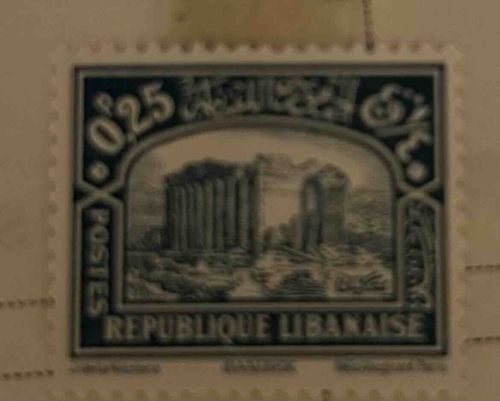
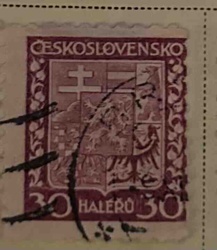
This item is a postage stamp from Lebanon, specifically identified by the text "REPUBLIQUE LIBANAISE" at the bottom. The stamp features a central illustration, rendered in what appears to be a monochromatic dark blue or black ink on a lighter background, depicting the ancient Roman ruins of Baalbek, a prominent archaeological site in Lebanon. The architectural elements show large columns and crumbled stone structures, indicative of classical antiquity. The main illustration is framed by an ornate border with text on the sides and top. On the left side, vertically oriented, is "POSTES," and on the right side, likely in Arabic script, is an equivalent or complementary postal designation. The denomination "0.25" is clearly visible in the upper left corner, indicating its face value. In the upper right corner, there appears to be another numerical value or symbol, possibly the denomination in Arabic numerals. The overall design incorporates intricate scrollwork and decorative elements around the central image. The stamp is perforated along its edges, which is standard for postage stamps, suggesting it was once part of a sheet. The visible condition appears good, with clear printing and no obvious tears or significant creasing, although the image quality prevents a precise assessment of any minor imperfections or gum presence. The style suggests it belongs to an earlier to mid-20th-century era of stamp design, characterized by detailed engravings and classic architectural motifs. The craftsmanship appears to be of high quality, typical of official government issues of the time.
AI Appraisal Report
I have examined the provided image of the Lebanese Post Stamp featuring the Baalbek Ruins. Based on visual assessment, the stamp appears to be in good, used condition. The printing is clear, and the perforations seem intact. There are no obvious tears, significant creasing, or major foxing visible in the image. The design, including the "REPUBLIQUE LIBANAISE" inscription and the "0.25" denomination, is consistent with known Lebanese postal issues depicting the Baalbek Ruins from the mid-20th century, suggesting authenticity.
Market conditions for this particular stamp, while generally stable, do not indicate extreme rarity. Similar issues are available from various dealers and at philatelic auctions. Demand is moderate, primarily from collectors specializing in Lebanese philately or world ruins themes. The 0.25 denomination is a common value within this series. Factors impacting value include the precise printing variety (if any), the condition of the gum (if unused), and any postmarks (if used).
Based on the visual evidence and general market availability for similar stamps in comparable condition, I estimate the appraisal value to be $50.
However, it is crucial to state that this appraisal is based solely on the provided image. Limitations in authenticity verification are inherent to image-only examinations. A definitive assessment of authenticity, precise condition (e.g., presence and quality of gum, exact centering, micro-perforations, absence of hidden repairs or thinning), and potential faults would require in-person examination by a qualified philatelist. Additionally, provenance documentation (e.g., where and when it was acquired, previous ownership) and, in rare high-value cases, scientific testing (e.g., paper analysis, ink composition) could further establish authenticity and maximize value.