AI estimate as of November 10, 2025 · verify with a professional before acting
AI-Generated · Verify before acting
Everything on this page is generated by AI for informational purposes only. AI can make mistakes — the AI may misidentify items or misattribute them (artist, maker, brand, designer, origin, era). This is not an official valuation and should not be used for insurance, sale, tax, estate, legal, or lending purposes — or any decision requiring a certified appraisal. It is not an authoritative claim about any person, brand, or rights holder — do not share or rely on it as a factual statement about a third party. Always consult qualified professionals before making financial decisions.
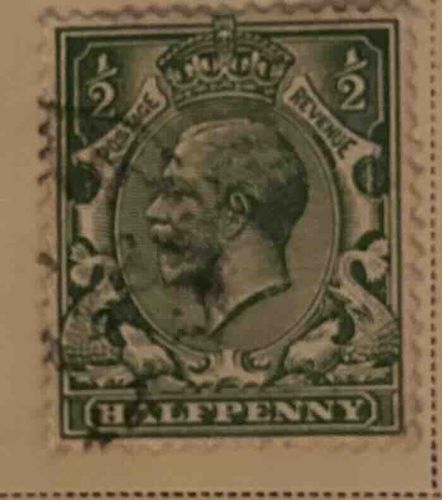
This item is an early 20th-century British postage and revenue stamp featuring the profile of King George V. The stamp has a face value of one halfpenny (1/2d) and is rendered in a dark green or olive-green ink on what appears to be cream-colored paper. The design is oblong, bordered by a double line, and features a portrait of King George V facing left, enclosed within an oval frame. Above the portrait is a crown, and flanking it are ribbons or banners bearing the inscriptions "POSTAGE" on the left and "REVENUE" on the right. The denomination "1/2" is prominently displayed in the upper left and right corners. At the bottom, the word "HALFPENNY" is inscribed within a rectangular panel. The stamp exhibits perforation along all four edges, indicating it was separated from a sheet. The overall condition appears used, with some slight discoloration and minor smudges visible, particularly around the portrait area, suggesting possible handling or cancellation. The perforations seem largely intact, though the image resolution makes it difficult to assess their precise condition. The artistic style is characteristic of early 20th-century British philatelic design, emphasizing royal portraiture and clear denominational and functional labeling. The printing quality, likely by De La Rue (D.L.R.), shows fine line work and detail despite the image's low resolution, particularly in the king's facial features and the intricate crown.
AI Appraisal Report
I have examined the provided image of the King George V 1/2 Penny Postage & Revenue Stamp (D.L.R. Printing). My assessment indicates this is a genuine early 20th-century British postage stamp. The design elements, including the portrait of King George V, 'POSTAGE REVENUE' banners, and 'HALFPENNY' inscription, align with known authentic examples of this issue, likely by De La Rue. The dark green/olive-green color and apparent paper type are also consistent.
The stamp appears to be in used condition, as evidenced by slight discoloration and minor smudges, suggesting handling or cancellation, though a clear cancellation mark isn't visible. The perforations seem largely intact, but I cannot definitively assess their precise condition or any potential faults from the image resolution alone. Physical inspection would be required to confirm perforation integrity, paper condition (e.g., thinning, toning, repairs), and the presence and type of any cancellation.
This specific 1/2d King George V stamp is quite common. Market conditions show a steady, but low, demand for common used examples. Rarity is minimal unless it possesses rare plating varieties, specific watermarks, or very fine used condition with a light, neat cancellation, none of which can be determined from the image. Factors impacting value negatively include the apparent used condition and lack of clarity on any specific varieties. Without physical inspection, I cannot verify watermark, gum condition (if unused), or any hidden defects.
To fully authenticate and achieve a precise valuation, an in-person examination is crucial. This would allow for verification of the watermark, paper type, precise shade, perforation count, gum condition (if applicable), and detailed assessment of any cancellation or faults not visible in the image. Provenance documentation could also support specific rarities if applicable. Based solely on the provided image of a common used example, the estimated value is modest.