AI estimate as of November 1, 2025 · verify with a professional before acting
AI-Generated · Verify before acting
Everything on this page is generated by AI for informational purposes only. AI can make mistakes — the AI may misidentify items or misattribute them (artist, maker, brand, designer, origin, era). This is not an official valuation and should not be used for insurance, sale, tax, estate, legal, or lending purposes — or any decision requiring a certified appraisal. It is not an authoritative claim about any person, brand, or rights holder — do not share or rely on it as a factual statement about a third party. Always consult qualified professionals before making financial decisions.
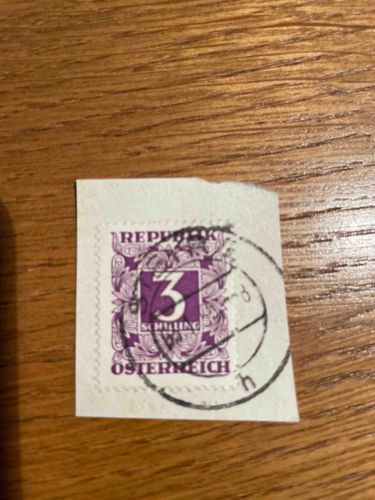
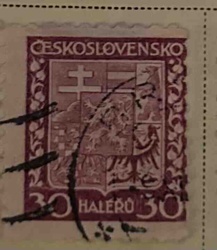
This item is a used postage stamp from Austria, specifically a 3 Schilling denomination from the Republic series. The stamp features a central design with the numeral '3' prominently displayed, with 'SCHILLING' written below it, all enclosed within an ornate, possibly Art Nouveau or early Art Deco inspired, decorative border. The color of the printed design is a rich purple or violet, set against an off-white paper background. The top edge of the stamp clearly shows 'REPUBLIK' and the bottom edge reads 'OSTERREICH', indicating the country of origin. The stamp exhibits visible signs of use, primarily a circular postmark in black ink that partially obscures the top right and bottom right portions of the design, extending onto the blank margins. The postmark appears to be a cancellation mark, indicating it has been used for postage. The edges of the stamp are not entirely smooth; the bottom and right edges show typical perforations, while the top and left edges appear to be either imperforate or roughly separated, possibly from a sheet that was previously imperforate on those sides or cut without precision. The paper itself shows some discoloration consistent with age and handling, and there's a slight brownish tone visible, especially on the edges. There are no obvious tears or significant creases, but the overall presentation suggests typical wear for a circulated stamp of this age. The printing quality appears to be consistent with governmental philatelic production of the early to mid-20th century. The visible details suggest an estimated age likely from the 1920s or 1930s, considering the 'Schilling' currency and the Republic period of Austria.
AI Appraisal Report
I have examined the image of this used Austria 3 Schilling stamp from the Republic series. Visually, the stamp appears genuine, consistent with philatelic issues from Austria during the 1920s or 1930s. The central '3 SCHILLING' design, 'REPUBLIK' and 'OSTERREICH' text, and the purple color against an off-white background align with known examples of this issue. The circular black postmark confirms its used status. The condition shows typical wear for a circulated stamp of this age, including age-related discoloration and a slight brownish tone. The perforations are present on the bottom and right, while the top and left appear either imperforate or roughly separated, which is not uncommon for stamps from this period or how they were separated from sheets. There are no obvious tears or significant creases. However, the heavy postmark partially obscures key design elements, which negatively impacts its aesthetic appeal and, consequently, its value for collectors who prioritize clear designs.
Market conditions for common, used issues from this period in Austria are generally stable but with low demand for heavily canceled examples. This specific stamp, while historically significant as part of the Republic series, is not considered rare in used condition. Comparables show that well-centered, lightly canceled examples might fetch slightly more, but heavily canceled stamps like this one typically fall into the lower end of the market.
Factors significantly impacting its value include the heavy cancellation, which detracts from its visual appeal, and its used condition. If this were a mint, unused example, its value would be considerably higher. Without physical inspection, I cannot definitively verify the authenticity of the paper, gum (if any remains), or the precise shade, nor can I confirm the absence of hidden faults such as thinning or repairs. A physical examination could confirm watermarks, paper type, and luminescence, which are crucial for full authentication and determining specific catalog variations. Provenance documentation would also add to its verifiable history, though this is less critical for common issues.