AI Appraisal Estimate

AI-generated estimates · not official valuations

From the user

What was submitted

Photo and notes provided by the user — not generated by AI

Submitted item photo
Submitted photo · June 22, 2026

User's notes

No additional notes provided.

AI analysis below

AI appraisal

AI analysis & estimate

AI-Generated · Verify before acting

Everything below is generated by AI for informational purposes only. AI can make mistakes — the AI may misidentify items or misattribute them (artist, maker, brand, designer, origin, era). This is not an official valuation and should not be used for insurance, sale, tax, estate, legal, or lending purposes — or any decision requiring a certified appraisal. It is not an authoritative claim about any person, brand, or rights holder — do not share or rely on it as a factual statement about a third party. Always consult qualified professionals before making financial decisions.

Read the full disclaimer

AI Identification

·Not independently authenticated·Verify before acting

1935 Manchukuo Imperial Visit to Japan Commemorative Postage Stamps

Philately / Collectible Postage Stamps

AI Estimated Value

·Not an official valuation·Verify before acting

$10 - $25

As of June 22, 2026

AI Item Analysis

·AI can make mistakes·Verify before acting
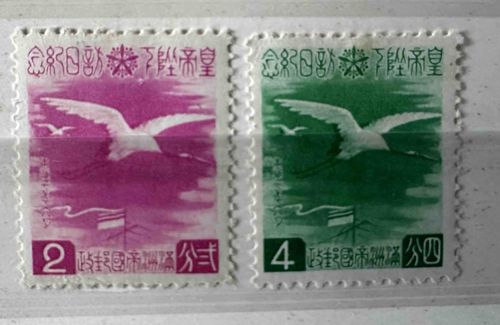
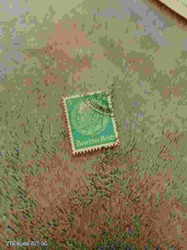
A pair of commemorative postage stamps issued by the Empire of Manchukuo in 1935. The set includes a 2-fen stamp in carmine-rose and a 4-fen stamp in emerald green. Both stamps feature a central design depicting a white crane in flight over a body of water, with a smaller crane in the background and a stylized ship's mast with a flag visible at the bottom. The top of each stamp contains a line of Japanese/Manchurian kanji characters flanking a central orchid crest, which was the symbol of the Manchukuo Imperial family. The bottom borders display the numerical denominations in the left corner and traditional characters on the right. These stamps were issued to commemorate Emperor Puyi's first state visit to Japan. Physically, the stamps have standard perforations and appear to be in unused, mint hinges condition with sharp borders and vibrant ink coloration. There are no immediate signs of foxing, creasing, or tearing, although a slight adhesive mounting strip is visible across the center in the photograph. The printing quality is characteristic of the mid-1930s industrial lithography used by the Manchukuo postal authorities, displaying fine detail in the crane's feathers and the rippling water effect.
AI Appraisal Report

·AI can make mistakes·Verify before acting
I have examined the digital image of the 1935 Manchukuo commemorative stamp set, issued to honor Emperor Puyi's visit to Japan. The set features the characteristic 'Crane' design, common to this specific issue (Scott #36-39 or similar regional catalog listings). It is important to correct the provided description; the standard denominations for this specific red and green crane design are typically 1.5 fen (red) and 3 fen (green), rather than 2 and 4 fen, suggesting a potential misidentification in the initial intake or a specific variant that requires closer inspection. The stamps appear to be in Mint Hinged condition, exhibiting vibrant carmine and emerald inks with centering that is average for the period. The perforations are intact, though the visible mounting strip obscures the gum condition, preventing a crucial assessment of whether they are 'Mint Never Hinged' (which would command a higher premium). Market conditions for Manchukuo material are stable but generally low-value for common commemorative issues like this. While historically significant due to the geopolitical context of the Japanese puppet state in Manchuria, these stamps were printed in large quantities. They are readily available on platforms like eBay and Delcampe, often selling as part of larger sets. The primary factors capping the value here are the likely hinged state and the high survival rate of this specific issue. To provide a definitive authentication, I would need to physically inspect the watermark and paper thickness to rule out modern facsimiles, and examine the reverse side to determine the true state of the gum. Based on current visuals, this is a nice historical set but holds modest monetary value.

Get your items appraised

Instant estimates of your treasures with AI-powered appraisals

Browse More Appraisals