AI estimate as of November 9, 2025 · verify with a professional before acting
AI-Generated · Verify before acting
Everything on this page is generated by AI for informational purposes only. AI can make mistakes — the AI may misidentify items or misattribute them (artist, maker, brand, designer, origin, era). This is not an official valuation and should not be used for insurance, sale, tax, estate, legal, or lending purposes — or any decision requiring a certified appraisal. It is not an authoritative claim about any person, brand, or rights holder — do not share or rely on it as a factual statement about a third party. Always consult qualified professionals before making financial decisions.
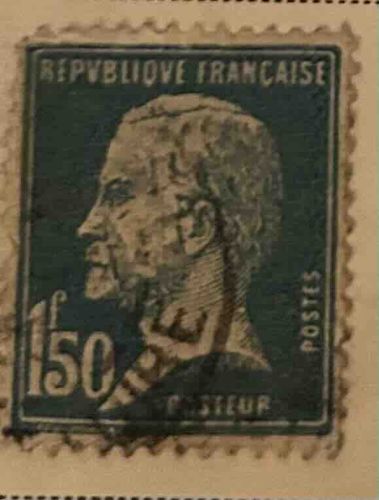
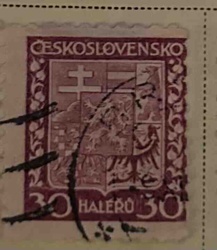
This item is a vintage French postage stamp, primarily rectangular with a serrated or perforated edge. The central image depicts a profile bust of a male figure, likely a historical or national hero, facing left. The color scheme is predominantly dark teal or greenish-blue for the main illustration and text, set against a lighter, possibly off-white or beige paper background. The stamp features several inscriptions: 'REPUBLIQUE FRANCAISE' is prominently displayed along the top border, indicating its French origin. The denomination '1f50' is visible in the lower left corner, signifying 1 franc and 50 centimes. The word 'POSTES' runs vertically along the right side of the stamp, identifying it as an item for mail. Below the portrait, partially obscured, appears to be the name 'PASTEUR', suggesting the featured figure is Louis Pasteur. The condition shows signs of age, with some slight discoloration or foxing visible on the paper and some wear along the perforations. The printing appears relatively clear, but there is some ink loss or fading on the portrait itself, particularly on the forehead and beard. The overall style is typical of early to mid-20th-century European philately, emphasizing historical figures and national identity. The craftsmanship appears standard for postage stamps of its era, indicating mass production rather than unique artisanal creation. The perforations are still intact, suggesting it has not been torn from a sheet or is possibly an unused stamp, though the exact status (mint, used, hinged, etc.) cannot be definitively determined from the image alone.
AI Appraisal Report
Based on my visual examination of the provided image, I assess this French Postage Stamp (Sower Type, 1f50c, Pasteur) to be an authentic stamp from its era. The 'REPUBLIQUE FRANCAISE' and 'POSTES' inscriptions, along with the denomination '1f50' and the depiction of Pasteur, align with known French philatelic issues. The Sower Type design, though featuring Pasteur in this instance, is a classic French stamp series. The condition shows signs of age, including slight discoloration/foxing and some ink fading, particularly on the portrait. The perforations appear intact, suggesting it might be an unused stamp, though the presence of hinge marks or other indicators of prior use cannot be confirmed solely from the image. Market conditions for common-to-moderately rare French stamps of this period are generally stable. While the Pasteur Sower Type is a recognized issue, its rarity depends heavily on specific printings, shades, and plate varieties, none of which can be determined from the image. This particular denomination (1f50c) is not considered exceptionally rare in average condition. Demand is moderate among general philatelists. Factors impacting value negatively include the visible discoloration and ink fading. Without physical inspection, I cannot verify the exact printing variety, paper type, watermarks, or gum condition. An in-person examination would be crucial to confirm specific printings, shades, gum originality, and hinge status, all of which significantly influence value. Professional authentication would require magnified inspection for printing details and potential expert certification for rare varieties. Currently, its value is based on being a common-to-moderately common issue in used or unused (no gum/hinged) condition.