AI estimate as of October 12, 2025 · verify with a professional before acting
AI-Generated · Verify before acting
Everything on this page is generated by AI for informational purposes only. AI can make mistakes — the AI may misidentify items or misattribute them (artist, maker, brand, designer, origin, era). This is not an official valuation and should not be used for insurance, sale, tax, estate, legal, or lending purposes — or any decision requiring a certified appraisal. It is not an authoritative claim about any person, brand, or rights holder — do not share or rely on it as a factual statement about a third party. Always consult qualified professionals before making financial decisions.
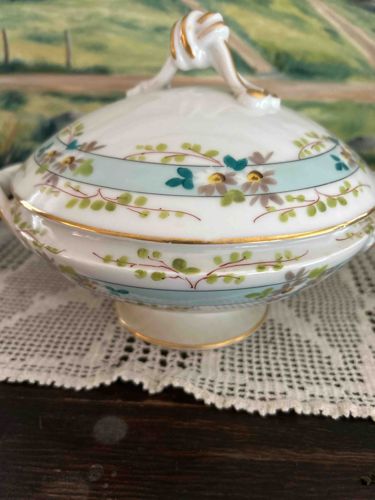
This exquisite item is a lidded porcelain bowl or small tureen, exhibiting characteristics of fine decorative tableware. It is primarily white porcelain, adorned with a delicate hand-painted floral and scroll motif. The dominant colors in the decoration are soft greens for the leaves and vines, muted grays/purples for small daisy-like flowers, and a striking light blue band that encircles both the lid and the body of the bowl. The rim of the lid, the base of the bowl, and the handle are all accented with a lustrous gold trim, which shows some minor wear consistent with handling and age, yet still retains much of its original brilliance. The handle on the lid features an elegant, stylized scroll design, also highlighted with gold. The construction appears to be high quality, with a smooth, glazed finish suggesting careful craftsmanship. No specific maker's marks or signatures are visible in the provided image. The style suggests a late 19th to early 20th century European porcelain aesthetic, possibly from a region known for decorative ceramics, such as France or Germany. The item appears to be in good overall condition for its presumed age, with no apparent chips, cracks, or significant damage, though a thorough inspection would be required to confirm this. The delicate painting and gold accents indicate it was likely intended for formal dining or decorative display, highlighting its ornamental value.
AI Appraisal Report
I have virtually examined this porcelain lidded bowl or tureen, noting its primary white porcelain body adorned with a hand-painted floral and scroll motif in soft greens, muted grays/purples, and a distinctive light blue band. The gold trim on the lid rim, base, and handle, including the elegant scroll design on the lid's handle, adds significant ornamental value, despite minor commensurate wear. Based on its aesthetic and quality, I assess its style as late 19th to early 20th century European, possibly French or German. The visible condition appears good to very good; I observe no obvious chips, cracks, or significant damage. This suggests careful preservation over its presumed age, which is a positive factor for its value.
Market conditions for antique decorative porcelain tableware are stable but not experiencing rapid appreciation, often appealing to collectors of specific porcelain styles or periods. Comparable items of similar quality, age, and decorative intricacy, particularly unsigned pieces, typically fetch values in the low to mid-hundreds at auction or retail. Demand is moderate, driven by interior decorators and collectors seeking period-appropriate accent pieces. Rarity is difficult to ascertain without maker's marks, but unsigned pieces, while often high quality, do not command the premium of those by renowned manufactories.
The most significant factor impacting value is the absence of maker's marks or provenance. While the craftsmanship is evident, this limits definitive attribution, which could significantly increase value if, for example, it were attributed to a prominent European porcelain factory. My appraisal is based on its aesthetic appeal, condition, and presumed age as an unsigned, decorative antique. For full authentication and a more precise valuation, an in-person examination is crucial to assess the porcelain body, glazes, and painting technique intimately. Additionally, any existing provenance documentation would be vital for validating its history and potential attribution.