AI estimate as of July 16, 2025 · verify with a professional before acting
AI-Generated · Verify before acting
Everything on this page is generated by AI for informational purposes only. AI can make mistakes — the AI may misidentify items or misattribute them (artist, maker, brand, designer, origin, era). This is not an official valuation and should not be used for insurance, sale, tax, estate, legal, or lending purposes — or any decision requiring a certified appraisal. It is not an authoritative claim about any person, brand, or rights holder — do not share or rely on it as a factual statement about a third party. Always consult qualified professionals before making financial decisions.
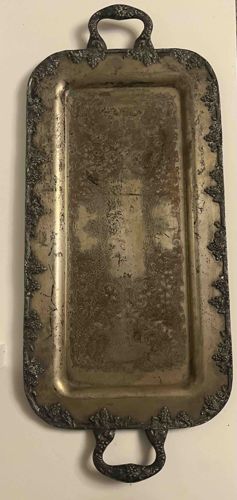
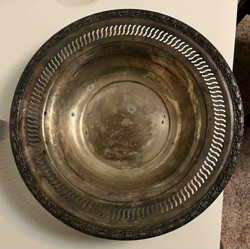
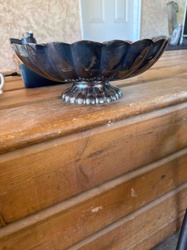
This item is a rectangular serving tray, likely made of silver-plated metal, given its tarnished appearance suggesting oxidation typical of silver. Its dimensions appear to be approximately 18-24 inches long and 8-12 inches wide, including the handles. The tray features an ornate, raised border along its long edges and curved short edges, adorned with what appears to be a repeating motif of leaves and possibly berries or grapes, indicative of a naturalistic or possibly Victorian aesthetic. Two sturdy, curved handles, matching the ornate style of the border, are attached to the short ends of the tray, allowing for easy carrying. The main surface of the tray is relatively flat, with a slight indentation to form a shallow well. The silver plating exhibits significant tarnish, appearing as dark brown and black discoloration across much of the surface. There are also visible areas where the silver plating may have worn away, revealing a duller, possibly brass or copper-toned base metal underneath, particularly in the central area and along the raised decorative elements. This wear is consistent with age and regular use. The craftsmanship, though obscured by tarnish, suggests a manufactured piece with molded or stamped decorative elements rather than hand-chased details, which points to mass production during the late 19th or early to mid-20th century. There are no immediate discernible maker's marks or signatures visible in the provided image. The overall condition suggests that the item would benefit from a thorough cleaning and polishing to restore its original luster, but the tarnish itself contributes to an aged patina character.
AI Appraisal Report
Upon examining the image of this silver-plated rectangular serving tray, I note its significant tarnish, consistent with silver oxidation, and visible wear suggesting loss of plating in several areas, particularly the center. This indicates typical age and use, aligning with its probable manufacturing period of late 19th to mid-20th century. The ornate, repeating leaf and vine motif on the raised border and handles strongly suggests a Victorian, Art Nouveau, or similar naturalistic aesthetic, likely mass-produced via molding or stamping rather than hand-chasing.
Market conditions for silver-plated trays are generally moderate; while there's consistent demand for functional and decorative pieces, extensive tarnish and plate loss can reduce appeal. Comparables often include similar ornate silver-plated trays from manufacturers like Wallace, Gorham, or Oneida, which typically fetch between $40-$150 depending on condition, size, and specific pattern. This tray’s substantial size (estimated 18-24 inches long) and ornate handles are attractive features that enhance its decorative value.
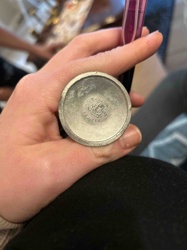
Factors significantly impacting its value include its current condition (heavy tarnish, plating loss) which would necessitate professional cleaning and potential replating to restore its original luster, a cost that new owners may factor in. While not rare, its age and decorative style offer a certain charm. The primary limitation in authenticating this piece from an image alone is the absence of visible maker's marks or hallmarks, which are crucial for precise dating, manufacturer identification, and confirming the silver-plate status, as opposed to solid silver. A physical examination would allow for tactile assessment of material, base metal identification, and a thorough search for hidden marks. Microscopy could also confirm plating thickness. Provenance documentation, if available, would further substantiate its history.