These notes were written by the person who submitted this item. Appraiser.AI has not verified them, and the AI's identification and estimate may rely on them.
AI Estimated Value
Not an official valuation
$5 - $15
AI estimate as of November 11, 2025 · verify with a professional before acting
AI-Generated · Verify before acting
Everything on this page is generated by AI for informational purposes only. AI can make mistakes — the AI may misidentify items or misattribute them (artist, maker, brand, designer, origin, era). This is not an official valuation and should not be used for insurance, sale, tax, estate, legal, or lending purposes — or any decision requiring a certified appraisal. It is not an authoritative claim about any person, brand, or rights holder — do not share or rely on it as a factual statement about a third party. Always consult qualified professionals before making financial decisions.
This analysis also relies on unverified notes provided by the user, which may be incomplete or inaccurate and could affect the result.
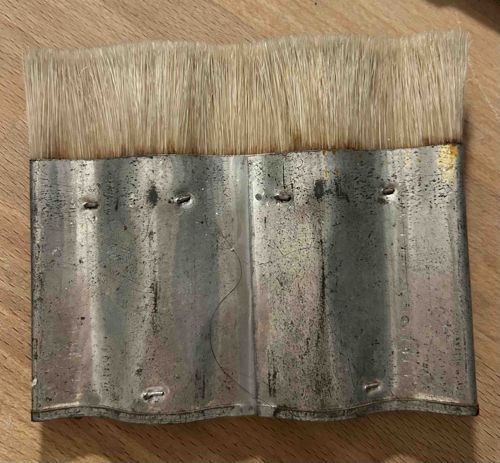
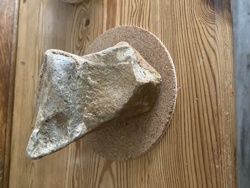
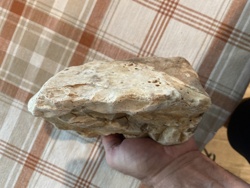
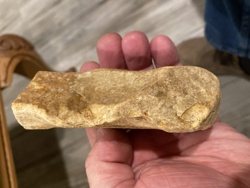
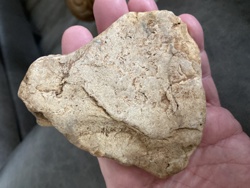
The item presented appears to be a flat industrial or utility brush head, possibly designed for applying coatings, cleaning, or sweeping. It features a wide, rectangular array of bristles, approximately 3-4 inches in length, that are light beige or off-white, suggesting natural fibers such as hog bristle or horse hair, which are common for heavy-duty applications. The bristles are dense and appear to be uniform in length, though some slight fraying or unevenness is visible at the very tips, indicative of use or storage.
The bristles are securely held within a metal ferrule, which exhibits a corrugated or wavy design. This ferrule is made of a silver-toned metal, likely steel or tin, and shows significant signs of age and wear. The surface of the metal is mottled with dark discoloration, pitting, and scratch marks, suggesting regular use in demanding conditions or prolonged exposure to elements. Several small, round indentations or rivets are visible along the top edge of the ferrule, where the bristles meet the metal, reinforcing their attachment. There are also irregularly shaped punctures or tears in the metal ferrule, particularly on the left side, which may be a result of manufacturing, damage, or a crude repair. A piece of dark filament, possibly a hair or fine wire, is caught on the surface of the ferrule, running diagonally. The overall construction appears robust, built for durability rather than aesthetic appeal. The edges of the ferrule are somewhat rough and uneven. The wavy pattern of the ferrule could be a design element for added strength or a method of attaching it to a handle (which is not visible in the image). The design does not suggest any particular artistic style or fine craftsmanship; rather, it indicates a utilitarian object. Given the wear and construction, it likely dates from the mid-20th century or earlier, when such materials and construction methods were common for tools.
AI Appraisal Report
I have examined the item described as a 'Flat Industrial Brush Head.' Based on the visual evidence, this appears to be a functional, heavy-duty utility brush, likely for industrial cleaning or application tasks. The densely packed, natural-fiber bristles (suggesting hog bristle or horse hair) and robust corrugated metal ferrule indicate a utilitarian purpose rather than decorative or specialized fine art use. The significant wear, discoloration, pitting, and irregular punctures on the ferrule are consistent with an item that has seen considerable use in a demanding environment or has been stored poorly over a long period. The overall condition is poor, with no evidence of aesthetic or collectible value.
There is a discrepancy between the item's appearance (a brush head) and the owner's description ("Antique cake knife"). The item is unequivocally not a cake knife. This misidentification severely impacts any perceived value based on the owner's initial description. Authenticity as an 'antique cake knife' is completely negated. As a utilitarian brush head, its authenticity as such is plausible given its construction and wear.
In terms of market conditions, similar worn, utilitarian brush heads have very limited interest in the collector's market. Their value is primarily functional, not antique or collectible. Demand is low, and rarity is not a factor; analogous items were mass-produced. There are no artistic or historical significances to elevate its value beyond scrap or a very low-end tool. Comparables would be other used, basic industrial or utility brushes, which typically sell for minimal amounts, if at all, to individuals needing a very basic tool. The lack of a handle further diminishes practical utility and value.
My appraisal is limited by the fact that I have only examined images. A physical inspection would allow for tactile assessment of bristle material, ferrule composition (e.g., specific metal type), and a more precise evaluation of manufacturing techniques and damage. However, given the nature of the object, these additional details would likely not significantly alter its appraised value. Provenance documentation or scientific testing is not applicable or necessary for this type of utilitarian item; its function and condition are self-evident from visual inspection. The most crucial factor impacting value here is its identity as a worn industrial brush, not an 'antique cake knife.'