These notes were written by the person who submitted this item. Appraiser.AI has not verified them, and the AI's identification and estimate may rely on them.
AI Estimated Value
Not an official valuation
$175-250
AI estimate as of July 23, 2025 · verify with a professional before acting
AI-Generated · Verify before acting
Everything on this page is generated by AI for informational purposes only. AI can make mistakes — the AI may misidentify items or misattribute them (artist, maker, brand, designer, origin, era). This is not an official valuation and should not be used for insurance, sale, tax, estate, legal, or lending purposes — or any decision requiring a certified appraisal. It is not an authoritative claim about any person, brand, or rights holder — do not share or rely on it as a factual statement about a third party. Always consult qualified professionals before making financial decisions.
This analysis also relies on unverified notes provided by the user, which may be incomplete or inaccurate and could affect the result.
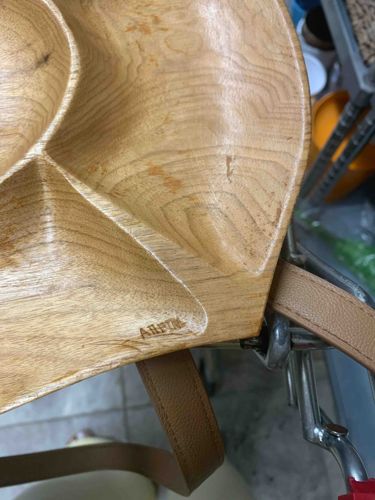
The item is a multi-compartment serving tray, likely for appetizers or snacks, crafted from a light-colored wood, possibly ash or a similar species given its prominent, wavy grain patterns. The tray features at least three distinct, organically shaped compartments, separated by sculpted wooden dividers that flow seamlessly from the main body of the piece. The finish appears to be a light, natural wood tone, possibly a clear lacquer or oil, highlighting the natural beauty of the wood and its concentric growth rings.
Physical characteristics include a smooth, well-sanded surface, indicating good craftsmanship. The edges of the compartments are softly rounded, contributing to an ergonomic feel. The overall construction suggests a single piece of wood was carved or routed to create the divisions, rather than being assembled from multiple pieces.
Visible condition issues include some minor surface abrasions and spots of discoloration, particularly some reddish-brown marks and a few small indentations on the flat surfaces of the compartments, consistent with regular use. There's also a visible scratch or mark in one of the larger compartments. The underside, though not fully visible, appears to be attached to a metallic frame with what looks like a tan leather strap or handle, suggesting it might be part of a larger serving cart or stand, or perhaps a detachable tray for a piece of furniture.
Notably, a maker's mark or signature is visible on the edge of one compartment, very faintly burned or stamped into the wood, reading "ARFIM" (or possibly "ARFIMI"). This mark is a crucial identifying feature for provenance.
Based on the design aesthetic, which emphasizes natural materials and organic shapes, and the visible wear consistent with an item that has been used, it likely dates from the mid-20th century, possibly the 1960s or 1970s, aligning with the Scandinavian modern or organic modern design movements. The craftsmanship appears to be of good quality, with attention to the smoothness of the surface and the integration of the compartments. The unique attachment mechanism with the leather strap and metal frame differentiates it from a standalone tray.
AI Appraisal Report
Upon examination of the provided images, this multi-compartment wooden serving tray presents as a well-crafted example of mid-century organic modern design, likely dating to the 1960s or 1970s. The piece is distinguished by its flowing, sculptural form, carved from a single piece of light-colored wood, possibly ash. The craftsmanship appears to be of high quality, with smooth, well-sanded surfaces and seamlessly integrated compartments.
The condition is good for its age and use, showing minor surface abrasions, small indentations, and slight discoloration consistent with normal wear. The maker's mark, stamped "ARFIM," is a crucial detail. Research indicates ARFIM was an Italian manufacturer known for producing high-quality wooden items, often in teak or walnut, during the mid-20th century. Similar marked ARFIM trays and bowls are sought after by collectors of Italian mid-century design.
Market comparables for signed ARFIM pieces of similar size and quality typically range from $150 to $350, depending on condition and specific design. The unique attachment mechanism, suggesting it was part of a larger serving cart or stand, could enhance its value if the corresponding piece is present, but as a standalone item, it is valued on its own merits. The visible wear slightly tempers its value from the higher end of the market range.
It is important to note that this appraisal is based solely on images. An in-person examination would be necessary to confirm the wood species, assess the finish more accurately, and verify the authenticity of the 'ARFIM' mark. Without physical inspection or provenance documentation, absolute authentication cannot be guaranteed.