These notes were written by the person who submitted this item. Appraiser.AI has not verified them, and the AI's identification and estimate may rely on them.
AI Estimated Value
Not an official valuation
$5 - $15
AI estimate as of November 9, 2025 · verify with a professional before acting
AI-Generated · Verify before acting
Everything on this page is generated by AI for informational purposes only. AI can make mistakes — the AI may misidentify items or misattribute them (artist, maker, brand, designer, origin, era). This is not an official valuation and should not be used for insurance, sale, tax, estate, legal, or lending purposes — or any decision requiring a certified appraisal. It is not an authoritative claim about any person, brand, or rights holder — do not share or rely on it as a factual statement about a third party. Always consult qualified professionals before making financial decisions.
This analysis also relies on unverified notes provided by the user, which may be incomplete or inaccurate and could affect the result.
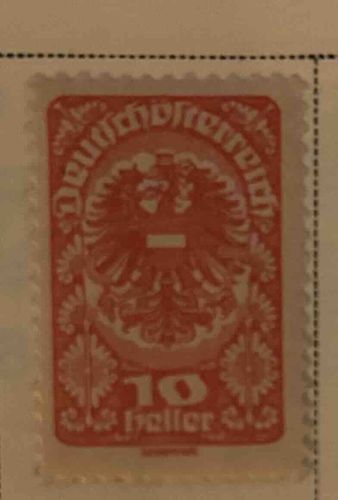
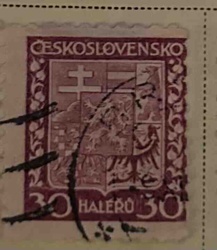
This item is a vintage rectangular postage stamp, predominantly rendered in a reddish-orange or terracotta hue on a lighter, possibly off-white, paper background. The stamp features a prominent central design of a stylized double-headed, crowned eagle, characteristic of the Austro-Hungarian or Austrian Republic's national emblem. The eagle is depicted with wings spread, symbolizing power and sovereignty. Above the eagle, encircling the top edge of the stamp, is the inscription "DeutschØsterreich" in an arc, indicating its origin as a stamp from German-Austria. Along the bottom edge, the denomination "10 Heller" is clearly visible, flanked by delicate floral or star-like motifs. Surrounding the central eagle and text, intricate floral or foliate patterns add decorative detail, particularly on the sides. The stamp exhibits classic perforation around all four edges, indicating it was produced for individual use from a larger sheet. The overall condition appears to be relatively good, with sharp perforations and a clear impression of the design, although minor age-related discoloration or very slight corner rounding cannot be entirely ruled out without further inspection. The design suggests a style period likely from the early 20th century, specifically the post-WWI era when German-Austria was established. The printing quality appears consistent with typical philatelic production methods of that time, showcasing fine line work for the intricate details.
AI Appraisal Report
Based on my visual examination of the provided image, this is an Austria Deutschösterreich 10 Heller stamp, featuring the double-headed eagle with floral motifs. The reddish-orange hue and design are consistent with issues from the post-WWI era, specifically Scott #189-192 or similar. The perforations appear intact and distinct, and the impression is clear, suggesting good printing quality for its age. I assess the condition to be Fine to Very Fine, though minor age-related discoloration or very slight corner rounding, typical for stamps of this period, cannot be entirely ruled out without a physical inspection.
In terms of market conditions, these early Deutschösterreich issues are relatively common, particularly in used condition. While aesthetically pleasing, they do not command extremely high prices unless they possess specific varieties (e.g., inverted watermarks, rare plate flaws) or are in pristine, unmounted mint condition with full original gum. The demand is steady among collectors of Austrian philately but not exceptionally high.
The rarity is low for a standard example of this stamp. Factors impacting value include the precise shade, exact perforation count (though often not a major driver for this specific issue), and crucially, the presence and quality of the gum if it's unused.
It is imperative to note that an authentic verification and final condition assessment cannot be definitively made from images alone. A physical examination would be required to verify gum condition (if mint), check for repairs, thins, hidden faults, accurate perforation count, and paper type. Provenance documentation could further enhance value, especially for higher value stamps, but is less critical for this common issue.