AI estimate as of November 10, 2025 · verify with a professional before acting
AI-Generated · Verify before acting
Everything on this page is generated by AI for informational purposes only. AI can make mistakes — the AI may misidentify items or misattribute them (artist, maker, brand, designer, origin, era). This is not an official valuation and should not be used for insurance, sale, tax, estate, legal, or lending purposes — or any decision requiring a certified appraisal. It is not an authoritative claim about any person, brand, or rights holder — do not share or rely on it as a factual statement about a third party. Always consult qualified professionals before making financial decisions.
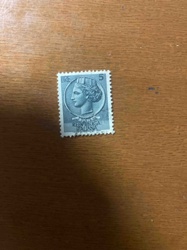
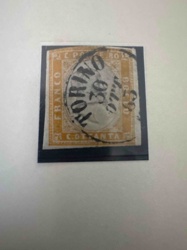
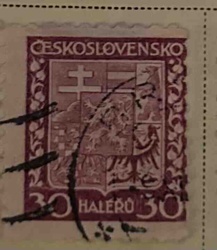
The item is a postage stamp featuring a side profile portrait of King Edward VIII, rendered in a light tone against a dark green background. The denomination '2/6' is prominently displayed in both the upper left and upper right corners. Below the portrait, the Royal Coat of Arms is depicted, flanked by a lion on the left and a unicorn on the right, both appearing to support the shield. The word 'POSTAGE' is clearly visible along the bottom edge of the stamp. The stamp itself is rectangular with perforated edges, indicative of its function as a postage stamp. There are clear signs of wear and tear, including a dark diagonal cancellation mark extending from the upper left to the lower right corner, obscuring parts of the King's portrait, the lion, and the Coat of Arms. Additional lighter, horizontal lines that could be further cancellations or creases are also discernible across the stamp's surface. The color scheme is predominantly dark green and light green/white, suggesting a specific printing or issuance. The exact age is not definitively stated, but based on the monarch, it would date to his reign in 1936. The overall condition suggests that it is a used stamp, given the cancellation marks, which is a common characteristic for collectible stamps. The printing quality appears fine, with intricate details in the coat of arms and the royal effigy, demonstrating careful execution typical of governmental postal issues.
AI Appraisal Report
Upon visual examination of the King Edward VIII 2/6 Postage Stamp, I observe a pre-decimal British stamp, distinguishable by the denomination '2/6'. The dark green and white color scheme is typical for this issue. The presence of a prominent cancellation mark, extending diagonally across the stamp, signifies it is a used example. Further lighter horizontal lines suggest additional cancellations or creasing, indicating significant use and handling. The perforated edges are consistent with standard postal issues of the era. The intricate detail in the portrait and Coat of Arms points to genuine governmental printing quality.
Authenticity, based solely on this image, seems probable given the typical design, but without physical inspection, I cannot rule out the possibility of a high-quality reproduction. The heavy cancellation significantly impacts the aesthetic appeal and, consequently, the market value. While King Edward VIII stamps are generally collectible due to his short reign, this specific 2/6 denomination, in a used and heavily canceled state, typically commands a lower price. Comparables for heavily canceled examples suggest a limited demand among collectors who prioritize pristine condition. Factors severely impacting value include the prominent cancellation obscuring key design elements.
For full authentication and a more precise valuation, an in-person examination is crucial. This would allow for verification of paper type, watermarks, gum condition (if unused), precise perforation count, and confirmation of relief printing methods. Provenance documentation, detailing the stamp's history and previous ownership, would also bolster authenticity. Scientific testing, such as spectroscopy for ink analysis, could definitively confirm the issue date and authenticity against known forgeries. Without these, the value remains an informed estimate.