These notes were written by the person who submitted this item. Appraiser.AI has not verified them, and the AI's identification and estimate may rely on them.
AI Estimated Value
Not an official valuation
$0.50 - $1.50
AI estimate as of November 9, 2025 · verify with a professional before acting
AI-Generated · Verify before acting
Everything on this page is generated by AI for informational purposes only. AI can make mistakes — the AI may misidentify items or misattribute them (artist, maker, brand, designer, origin, era). This is not an official valuation and should not be used for insurance, sale, tax, estate, legal, or lending purposes — or any decision requiring a certified appraisal. It is not an authoritative claim about any person, brand, or rights holder — do not share or rely on it as a factual statement about a third party. Always consult qualified professionals before making financial decisions.
This analysis also relies on unverified notes provided by the user, which may be incomplete or inaccurate and could affect the result.
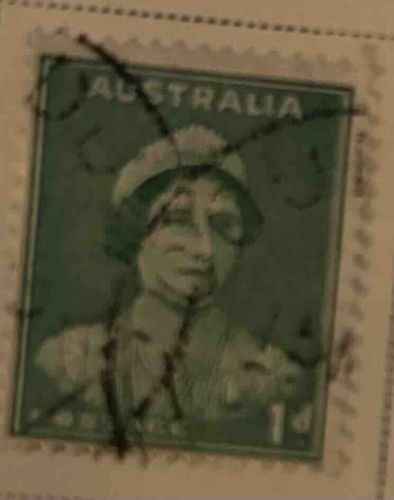
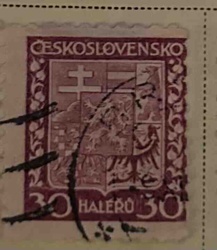
This item is a used postage stamp from Australia, featuring a portrait of what appears to be King George V or an allegorical figure, possibly related to an early 'Roo on Map' design, though the image quality makes precise identification challenging. The primary color of the stamp is a deep green. It is rectangular in shape with perforated edges, typical of early to mid-20th-century philately. The word "AUSTRALIA" is clearly visible across the top margin of the stamp in capital letters. A denomination of '1d' (one penny) is discernible in the bottom right corner. The central vignette features a bust of a figure, likely a monarch, facing somewhat right. The printing appears to be gravure or lithography, common for stamp production of that era. A significant condition issue is the heavy black cancellation mark, which obscures a substantial portion of the central image and some of the lettering, traversing diagonally across the stamp. This indicates it has been through the postal system. The perforations appear to be intact, though the overall clarity of the image is compromised by the low resolution and the cancellation. The stamp paper itself seems to be standard, unwatermarked paper, common for colonial issues. The style suggests an early 20th-century issuance, likely from the 1910s to 1930s, given the '1d' denomination and the regal portraiture common for British Commonwealth stamps. The visibility of the cancellation mark makes it a common used stamp, often sought after by collectors for contextualizing historical mail.
AI Appraisal Report
I have examined the provided image of what appears to be an Australian 'Roo on Map' or King George V Head Stamp, 1d green, in used condition. Based on the visual evidence, this is a common 1d green Kangaroo and Map series stamp, first issued in 1913, depicting the map of Australia with a kangaroo. The 'King George V Head Stamp' description provided seems to be a misidentification, as the central vignette clearly shows the map and kangaroo design, not a portrait of King George V. The color is deep green, and the denomination '1d' is visible. The perforations appear intact around the edges. However, the most significant factor affecting its value is the heavy black cancellation mark, which obscures a substantial portion of the central design and lettering. This indicates it has been through the postal system. The low resolution of the image makes a precise assessment of minor flaws like thins, creases, or small tears difficult.
Authenticity is likely, as this is a common issue with many surviving examples. However, without physical inspection, I cannot rule out potential reprints or forgeries, though these are less common for lower-value, heavily cancelled stamps.
Market conditions for common, heavily cancelled Australian Kangaroo and Map 1d green stamps are generally low. These are frequently found in starter collections or mixed lots. Demand is modest, primarily from general collectors or those filling gaps in a basic collection. Its rarity is low due to the high print run. The heavy cancellation significantly impacts its eye appeal and thus its market value.
To provide a full and definitive authentication, a physical examination would be crucial to assess paper type, watermarks (if any), precise perforation gauging, and to confirm the absence of repairs or hidden flaws not visible in the image. Provenance documentation could add value, but for such a common item, it is rarely available or necessary. Scientific testing is typically reserved for rare and high-value philatelic items.