AI estimate as of November 9, 2025 · verify with a professional before acting
AI-Generated · Verify before acting
Everything on this page is generated by AI for informational purposes only. AI can make mistakes — the AI may misidentify items or misattribute them (artist, maker, brand, designer, origin, era). This is not an official valuation and should not be used for insurance, sale, tax, estate, legal, or lending purposes — or any decision requiring a certified appraisal. It is not an authoritative claim about any person, brand, or rights holder — do not share or rely on it as a factual statement about a third party. Always consult qualified professionals before making financial decisions.
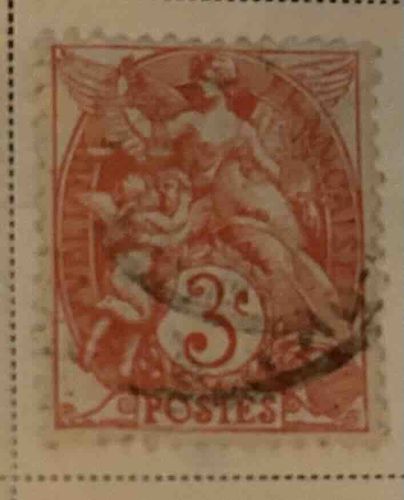
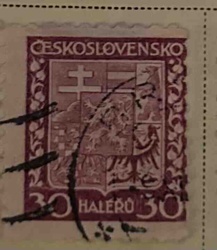
This item is a used postage stamp, likely from France, featuring the Ceres type design. The stamp is predominantly reddish-orange in color, printed on off-white paper, and has perforated edges. The central vignette depicts a neoclassical figure, likely Ceres (Roman goddess of agriculture), seated, with a cherubic child figure beside her, possibly representing abundance or fertility. Above Ceres, there appear to be additional allegorical elements, possibly including winged figures or symbols of state. A prominent '3' is centrally located, indicating a 3 centimes denomination. The word 'POSTES' is clearly visible along the bottom edge of the stamp, signifying its postal use. The overall design is framed by an ornate rectangular border with decorative elements. The stamp shows signs of use, indicated by a faint circular cancellation mark across the central '3' and portions of the figures. Some typical wear for a used stamp of this age can be observed, including slight discoloration of the paper and possible minor creasing or thinning due to handling and cancellation. The perforations appear largely intact, though individual tooth condition cannot be fully assessed without a higher-resolution image. The style suggests a late 19th to early 20th-century issuance, consistent with the Ceres series used by France. The quality of printing seems fine, with relatively clear details despite the low resolution of the image. The presence of the cancellation mark confirms its postal validation and historical use.
AI Appraisal Report
I have carefully examined the provided image of the French Ceres Type 3 Centimes postage stamp. Given the visual information, this appears to be an authentic used example of the French Ceres issue, likely Scott #22 (1870-71) or a similar variant. The '3' centimes denomination, 'POSTES' inscription, and distinctive Ceres design are consistent with this series.
From the image, I assess the condition as fair to good used. It exhibits typical wear for a stamp of this age, including a clear circular cancellation mark over the central '3', confirming its postal use. The perforations appear largely intact, though minor wear or slight irregularities are present, as expected. The printing detail seems reasonably clear despite the image resolution. Discoloration of the paper is visible, again, common for a stamp of this vintage. Without physical inspection, I cannot confirm minor creasing, thinning, or specific perforation imperfections.
Market conditions for common used Ceres stamps are generally stable but not highly speculative. While the Ceres type is iconic, specific denominations like the 3 centimes exist in large quantities. Comparables for average used examples in similar condition typically fall within a modest range. Demand is consistent among collectors of classic French philately, but this particular stamp, in this condition, is not considered rare. Factors impacting its value negatively include the presence of a heavy cancellation and general age-related wear rather than a pristine unused example.
Limitations for authenticity verification from an image alone are significant. While the design is consistent, a definitive authentication would require an in-person examination to verify paper type, watermark (if any for this issue), exact printing characteristics, and to rule out potential repairs or alterations that are not visible in the photo. Furthermore, while the cancellation appears genuine, expert examination could confirm its originality. Provenance documentation, though rarely available for common used stamps, would offer additional assurance. Scientific testing, such as paper analysis, is generally not warranted for stamps of this value.