These notes were written by the person who submitted this item. Appraiser.AI has not verified them, and the AI's identification and estimate may rely on them.
AI Estimated Value
Not an official valuation
$25 - $75
AI estimate as of November 10, 2025 · verify with a professional before acting
AI-Generated · Verify before acting
Everything on this page is generated by AI for informational purposes only. AI can make mistakes — the AI may misidentify items or misattribute them (artist, maker, brand, designer, origin, era). This is not an official valuation and should not be used for insurance, sale, tax, estate, legal, or lending purposes — or any decision requiring a certified appraisal. It is not an authoritative claim about any person, brand, or rights holder — do not share or rely on it as a factual statement about a third party. Always consult qualified professionals before making financial decisions.
This analysis also relies on unverified notes provided by the user, which may be incomplete or inaccurate and could affect the result.
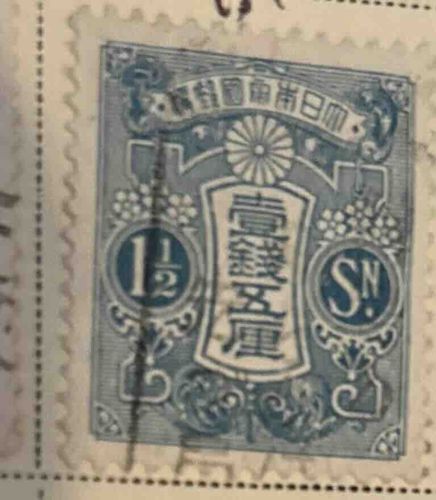
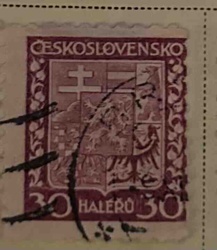
This is a vintage Japanese postage stamp, specifically a 1 1/2 Sen denomination, featuring a design characteristic of late 19th or early 20th century Japanese philately. The stamp is predominantly blue and white, with intricate detailing and ornate scrollwork, indicative of the artistic style prevalent during its likely period of issue. The central motif appears to be a stylized Chrysanthemum, a national symbol of Japan, positioned above a vertical banner with Japanese characters. To the left, within a circular frame, is the numerical denomination '1 1/2', clearly indicating its value. To the right, also in a circular frame, are the letters 'SN', though their specific significance without further context is unclear. The overall rectangular shape is enhanced by a perforated edge, typical of postage stamps, suggesting it was originally part of a larger sheet. The physical condition shows some signs of age, with slight discoloration or toning visible on the paper, consistent with its vintage. There are no obvious tears, creases, or major repairs, but the image resolution makes it difficult to assess minor imperfections or the presence of a hinge mark on the reverse. The printing quality appears to be consistent with gravure or lithography, common methods for producing stamps during this era, and the fine lines and detailed patterns speak to a good level of craftsmanship. The aesthetic suggests a Meiji or early Taisho period issue, likely falling within the late 1800s to early 1900s.
AI Appraisal Report
Based on my visual examination of the provided image of the Japanese 1 1/2 Sen stamp, I assess its condition as good vintage. The slight discoloration and toning are consistent with its age, and I observe no obvious tears, creases, or major repairs. The design, featuring the Chrysanthemum and vertical Japanese characters, aligns with Japanese philately of the late 19th or early 20th century, likely from the Meiji or early Taisho period. The presence of 'SN' next to the '1 1/2' denomination is unusual for standard Japanese issues of this period and would require further research for definitive understanding, but it does not immediately suggest inauthenticity.
Authenticity, based solely on an image, is difficult to confirm definitively. While the design and printing quality appear consistent with period methods, minor imperfections or the presence of hinge marks cannot be fully discerned. Market conditions for common Japanese stamps of this era are generally stable, but rarely command exceptionally high prices unless in mint, unhinged condition or possessing specific, rare varieties. This particular denomination is not considered a high-value rarity based on typical catalog listings.
Demand for common Japanese issues remains steady among collectors. The condition, while good, is not pristine, which impacts the top end of its potential value. Factors influencing value include overall centering, gum condition (not visible), and any potential cancellation clarity (if used). To fully verify authenticity and precisely assess condition, an in-person examination would be crucial to check for watermarks, paper type, gum integrity, and any hidden repairs or alterations. Provenance documentation, if available, would further enhance authentication.