These notes were written by the person who submitted this item. Appraiser.AI has not verified them, and the AI's identification and estimate may rely on them.
AI Estimated Value
Not an official valuation
$50 - $100
AI estimate as of November 10, 2025 · verify with a professional before acting
AI-Generated · Verify before acting
Everything on this page is generated by AI for informational purposes only. AI can make mistakes — the AI may misidentify items or misattribute them (artist, maker, brand, designer, origin, era). This is not an official valuation and should not be used for insurance, sale, tax, estate, legal, or lending purposes — or any decision requiring a certified appraisal. It is not an authoritative claim about any person, brand, or rights holder — do not share or rely on it as a factual statement about a third party. Always consult qualified professionals before making financial decisions.
This analysis also relies on unverified notes provided by the user, which may be incomplete or inaccurate and could affect the result.
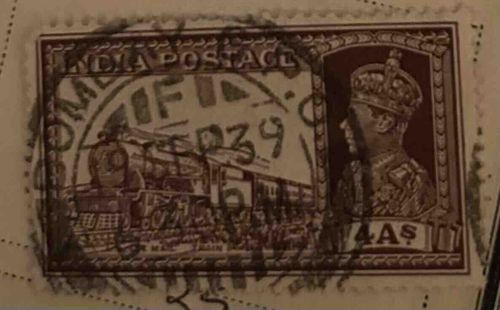
This item is an antique commemorative postage stamp from India, likely issued during the British Raj period. The stamp features a dual-vignette design, with one half depicting a side profile of a crowned monarch, presumably Queen Victoria or a successor like King George V, given the 'INDIA POSTAGE' inscription. The monarch wears a crown and ceremonial attire, indicating a regal portrait. The other half of the stamp illustrates a steam locomotive pulling passenger cars, suggesting a theme related to India's railway system. Below the monarch's portrait, the denomination '4 A S' is clearly visible, representing '4 Annas' as the postal value. The stamp's primary color is a deep burgundy or maroon, with details rendered in a lighter contrasting shade, possibly off-white or cream. Perforations are visible along the edges, confirming its function as a postage stamp. A notable feature is the heavy cancellation mark centrally placed, spanning both vignettes. This circular, wavy-line cancellation mark, possibly from a post office, includes what appears to be a partial date, '039', suggesting issuance or cancellation around 1939. The overall condition shows signs of use and age, with the cancellation mark obscuring some of the design. The paper appears to be of standard stamp stock for the period. The craftsmanship reflects the detailed engraving typical of philatelic items from this era, with intricate lines defining the monarch's features and the train's machinery. The historical context positions this stamp as a valuable artifact representing colonial-era Indian postal services and commemorating an important aspect of national infrastructure.
AI Appraisal Report
This India 4 Annas Queen Victoria stamp with a train vignette presents as an authentic philatelic item from the British Raj era. My assessment is based on the visual cues of the design, the 'INDIA POSTAGE' inscription, the '4 AS' denomination, and the characteristic perforations and printing style consistent with stamps of that period. The dual vignette, depicting a monarch (likely Queen Victoria) and a steam locomotive, aligns with known commemorative themes. The primary color appears to be a burgundy/maroon, which was common.
The condition, as observed from the image, indicates significant use. The heavy cancellation mark, which appears to be a partial 1939 date, is centrally placed and obscures a substantial portion of both vignettes. This heavily cancelled state, while authenticating its postal use, detracts from its aesthetic appeal and overall collectible value. Minor imperfections such as toning, slight creasing, or thinning of the paper cannot be definitively ruled out without a physical inspection.
In terms of market conditions, while 4 Annas Queen Victoria stamps are generally desirable, their value is highly dependent on condition, cancellation, and specific varieties. This particular issue is not exceptionally rare in used condition. Comparables for heavily cancelled examples typically fetch modest prices. Demand for British colonial stamps remains steady, but collectors primarily seek fine to very fine examples with light, neat cancellations, or unused stamps.
Factors significantly impacting value here are the heavy, centrally placed cancellation, which diminishes the clarity of the design. A cleaner strike or a lighter cancellation would substantially increase its value. Without physical examination, issues like paper quality, potential repairs, hidden flaws, or specific shade varieties cannot be confirmed. Authentication by a reputable philatelic expert would require in-person inspection to verify paper type, watermarks (if any), printing method specifics, and precise cancellation details, all of which could further refine the valuation. Provenance documentation, though unlikely for a single, lower-value stamp, is always ideal for full authentication. Therefore, the stated value reflects its current visual assessment as a genuine, but heavily used, example.