These notes were written by the person who submitted this item. Appraiser.AI has not verified them, and the AI's identification and estimate may rely on them.
AI Estimated Value
Not an official valuation
$50 - $100
AI estimate as of November 9, 2025 · verify with a professional before acting
AI-Generated · Verify before acting
Everything on this page is generated by AI for informational purposes only. AI can make mistakes — the AI may misidentify items or misattribute them (artist, maker, brand, designer, origin, era). This is not an official valuation and should not be used for insurance, sale, tax, estate, legal, or lending purposes — or any decision requiring a certified appraisal. It is not an authoritative claim about any person, brand, or rights holder — do not share or rely on it as a factual statement about a third party. Always consult qualified professionals before making financial decisions.
This analysis also relies on unverified notes provided by the user, which may be incomplete or inaccurate and could affect the result.
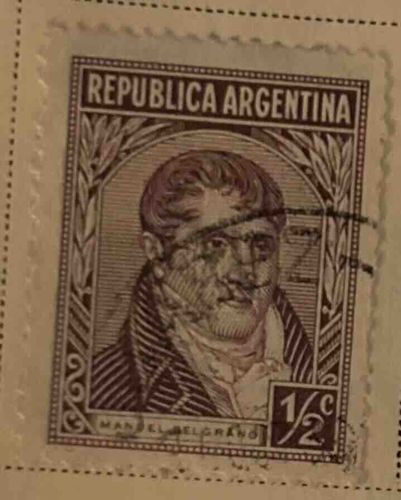
This is a vintage postage stamp from Argentina, featuring a portrait of Manuel Belgrano. The stamp is predominantly purple or a rich violet-brown color, printed on what appears to be off-white or cream-colored paper. It is rectangular with perforated edges, indicating it was part of a sheet of stamps. The central design is a detailed bust portrait of Manuel Belgrano, presented within an arched frame. He is depicted in a formal, possibly military-style, coat and ruffled cravat, with a serious expression. His hair appears to be styled relatively short, consistent with early 19th-century fashion. The top of the stamp prominently displays "REPUBLICA ARGENTINA" in a sans-serif or block-letter font, encased within a decorative rectangular border. Below the portrait, the name "MANUEL BELGRANO" is clearly visible in a smaller, more refined script. In the bottom right corner, the denomination "1/2 C" is enclosed in a small square, indicating a value of half a centavo. The overall design incorporates intricate scrollwork and floral or leafy motifs on the sides of the portrait frame, adding to its classic aesthetic. The stamp shows signs of age and handling, with some visible creasing or disturbance on Belgrano's face and possibly some light smudging or dirt adhered to the surface. The perforations appear largely intact, though the paper might show some light toning consistent with its age. The printing quality appears good, suggesting a standard government issue. The stamp's style and the prominent figure suggest it likely dates from the late 19th or early 20th century, a period when national heroes were frequently honored on currency and postage.
AI Appraisal Report
This Manuel Belgrano 1/2 Centavo Postage Stamp from Argentina appears, based on visual examination, to be an authentic issue. The design, printing style, and denomination of '1/2 C' are consistent with known examples of this stamp, likely from the late 19th or early 20th century. The portrait of Manuel Belgrano is well-defined, and the surrounding text 'REPUBLICA ARGENTINA' and 'MANUEL BELGRANO' are clearly legible.
The condition, however, significantly limits its value. I observe visible creasing, particularly across Belgrano's face, and some surface disturbance which could be smudging or a light stain. While the perforations appear largely intact, the overall impression is that of a used, unrestored stamp with condition issues. In the philatelic market, condition is paramount, and these flaws detract considerably from its desirability.
Market demand for common stamps of this era and type from Argentina is moderate. While Belgrano is a significant national figure, this particular denomination and issue are not considered rare, especially in used condition. Comparables in fine-to-very-fine used condition typically fetch higher prices, but this example falls below that standard. The value reflects its historical interest rather than its philatelic perfection.
My appraisal is limited by the visual information available through images only. A definitive assessment of authenticity, gum condition (if unused, though this appears used), paper type, watermarks, and precise perforation count would require in-person examination. Physical inspection would also allow for a more accurate assessment of any repairs, thinning, or hidden damage that might not be visible in photographs.