AI estimate as of October 2, 2025 · verify with a professional before acting
AI-Generated · Verify before acting
Everything on this page is generated by AI for informational purposes only. AI can make mistakes — the AI may misidentify items or misattribute them (artist, maker, brand, designer, origin, era). This is not an official valuation and should not be used for insurance, sale, tax, estate, legal, or lending purposes — or any decision requiring a certified appraisal. It is not an authoritative claim about any person, brand, or rights holder — do not share or rely on it as a factual statement about a third party. Always consult qualified professionals before making financial decisions.
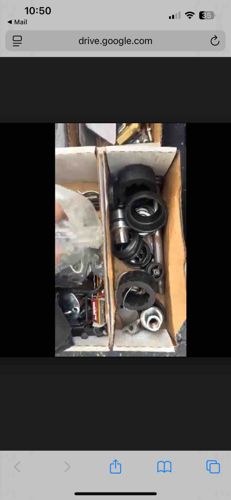
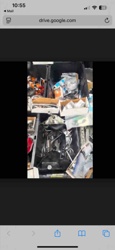
The image displays a collection of assorted mechanical parts, likely for an automotive application or other machinery, loosely organized within at least two open cardboard boxes. The visible parts include components made predominantly of metal, ranging from shiny, possibly chrome-plated or polished steel, to darker, potentially cast iron or anodized aluminum. Several rubber or plastic seals, gaskets, and bushings are also interspersed among the metallic pieces. Notable metallic components include various cylindrical shafts, gears, bearings, and housings. Some parts appear to be threaded, suggesting they are designed to be fastened. The overall condition of the parts appears to be used; some exhibit signs of wear, such as scuffs, minor scratches, and what might be grease or grime build-up, indicative of previous use or storage without thorough cleaning. There are no clear manufacturer's marks, stamps, or signatures discernible in the provided image. Due to the diverse nature of the components and the lack of identifying marks or context, precise manufacturing details or a definitive style period are difficult to ascertain. However, the presence of both metallic and non-metallic components suggests modern manufacturing practices, likely post-mid-20th century. The parts do not show significant signs of corrosion or heavy damage, implying they might be spares, 'take-off' parts, or components awaiting assembly or sorting. The craftsmanship seems standard for functional mechanical parts, emphasizing durability and precision for fitting.
AI Appraisal Report
Upon visual examination of the provided image, I observe a collection of assorted automotive or machinery parts contained within cardboard boxes. The majority of components appear to be metallic, including shafts, gears, bearings, and housings, complemented by various rubber or plastic seals and bushings. The condition of these parts suggests they are used, exhibiting scuffs, minor scratches, and some potential grease/grime, indicative of prior use or informal storage. There are no discernible manufacturer's marks or part numbers visible, which significantly limits precise identification and authentication.
Assessing authenticity from images alone is challenging. While the parts appear to be genuine mechanical components, their specific origin, make, and model compatibility cannot be confirmed without closer inspection. Without documentation or specific markings, it's impossible to verify if they are OEM, aftermarket, or from a particular vintage. This lack of clear identification is the primary factor impacting valuation.
Market conditions for assorted used mechanical parts are generally low unless they can be precisely identified as rare, high-demand, or specialized components for a specific vehicle or machine. Without such identification, these parts would likely be sold as a generic lot for scrap, salvage, or as a 'mystery box' to hobbyists. Demand for unidentified, used parts is typically minimal. Rarity is impossible to determine without knowing what these parts are specifically for.
Factors significantly impacting value include the unknown origin, lack of specific application, and the used condition. If these components could be definitively identified as parts for a classic, rare, or high-performance vehicle, their value could increase substantially. However, as presented, they are common-looking mechanical components.
For full authentication and a more precise valuation, an in-person examination would be critical to identify any hidden markings, assess material composition more accurately, and potentially measure dimensions. Provenance documentation, such as service records or original packaging, would be invaluable. Scientific testing might be required to confirm material composition for specialized applications, but this is unlikely for general automotive or machine parts.