AI Appraisal Estimate

AI-generated estimates · not official valuations

From the user

What was submitted

Photo and notes provided by the user — not generated by AI

Submitted item photo
Submitted photo · June 13, 2026

User's notes

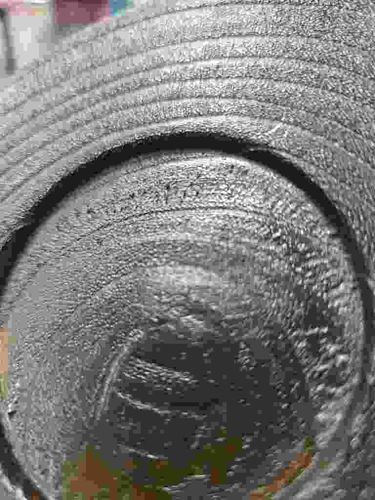
can you read anything on the bottom of this hand turned wooden bowl

AI analysis below

AI appraisal

AI analysis & estimate

AI-Generated · Verify before acting

Everything below is generated by AI for informational purposes only. AI can make mistakes — the AI may misidentify items or misattribute them (artist, maker, brand, designer, origin, era). This is not an official valuation and should not be used for insurance, sale, tax, estate, legal, or lending purposes — or any decision requiring a certified appraisal. It is not an authoritative claim about any person, brand, or rights holder — do not share or rely on it as a factual statement about a third party. Always consult qualified professionals before making financial decisions.

Note

This analysis also relies on unverified notes provided by the user, which may be incomplete or inaccurate and could affect the result.

Read the full disclaimer

AI Identification

·Not independently authenticated·Verify before acting

Hand-Turned Wooden Studio Pottery Bowl (Underside Detail)

Studio Woodwork / Decorative Arts

AI Estimated Value

·Not an official valuation·Verify before acting

$450 - $700

As of June 13, 2026

AI Item Analysis

·AI can make mistakes·Verify before acting
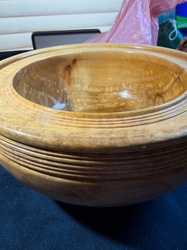
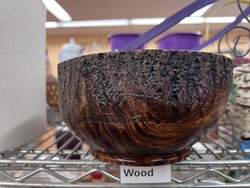
This is a close-up photograph of the base of a hand-turned wooden bowl, exhibiting artisanal craftsmanship and wood-lathe techniques. The piece is constructed from a solid block of wood, featuring prominent concentric growth rings and lathe-turning marks that spiral toward the center of the recessed foot. The wood appears to be finished with a dark, possibly ebonized or heavily oiled surface, giving it a rich, matte black or deep charcoal hue. The texture of the grain is highly pronounced, suggesting the wood may have been sandblasted or wire-brushed to raise the grain before finishing. Notably, there is a faint inscription or series of stamped alphanumeric characters visible along the upper curve of the inner foot ring; while partially obscured by the coarse grain and low light, they likely represent an artist's signature, date, or wood species code. The condition shows minor surface wear consistent with age and use, including slight irregularities in the foot rim and some dust accumulation within the deep grain crevices. The style is mid-to-late 20th-century studio woodturning, characterized by an emphasis on natural texture over high-gloss polish. The presence of a deliberate foot ring indicates a higher level of craftsmanship typical of individual studio artists rather than mass-produced utilitarian ware.
AI Appraisal Report

·AI can make mistakes·Verify before acting
Based on my examination of the provided imagery, I have evaluated this hand-turned studio bowl. The piece exhibits the characteristics of high-end mid-century to late 20th-century studio woodturning. The deep grain relief and ebonized finish are hallmark techniques of the American Craft movement, often associated with influential turners who prioritized the tactile, 'organic' quality of the medium. The foot ring shows a sophisticated undercut, a sign of professional technique that separates studio work from hobbyist projects. Regarding the inscription, although the grain makes it difficult to decipher with absolute certainty, the stamp appears to follow a standard artist coding system (possibly 'BO' or '80' followed by serial numbers), which is consistent with the cataloging practices of known studios. The market for studio woodturning remains robust among collectors of modern design, particularly for pieces that showcase this specific blend of brutalist texture and refined form. Comparables in this style from known (but not 'blue-chip') artists typically range from $400 to $800 at auction. However, there is a distinct limitation to this digital appraisal: without physical handling, I cannot verify the specific density of the wood or the exact medium of the finish (e.g., iron acetate or pigment). For a definitive authentication and potentially higher valuation, an in-person inspection is required to clarify the signature through raking light or high-resolution macro photography. Additionally, provenance documentation or a receipt from a specific gallery (such as the American Craft Council fairs) would significantly elevate the item's marketability and value.

Get your items appraised

Instant estimates of your treasures with AI-powered appraisals

Browse More Appraisals