These notes were written by the person who submitted this item. Appraiser.AI has not verified them, and the AI's identification and estimate may rely on them.
AI Estimated Value
Not an official valuation
$5 - $15
AI estimate as of November 10, 2025 · verify with a professional before acting
AI-Generated · Verify before acting
Everything on this page is generated by AI for informational purposes only. AI can make mistakes — the AI may misidentify items or misattribute them (artist, maker, brand, designer, origin, era). This is not an official valuation and should not be used for insurance, sale, tax, estate, legal, or lending purposes — or any decision requiring a certified appraisal. It is not an authoritative claim about any person, brand, or rights holder — do not share or rely on it as a factual statement about a third party. Always consult qualified professionals before making financial decisions.
This analysis also relies on unverified notes provided by the user, which may be incomplete or inaccurate and could affect the result.
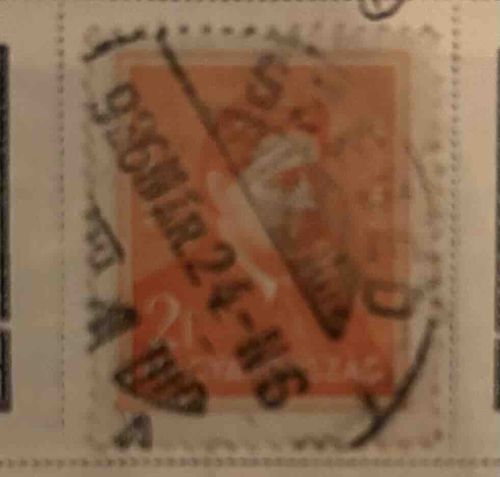
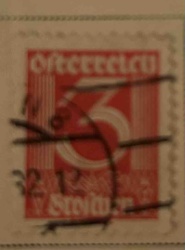
This item is a Hungarian revenue stamp, characterized by its reddish-orange color and rectangular shape, indicative of its origin and purpose. The stamp appears to be made from a thin paper material, typical of philatelic items. The physical dimensions cannot be exactly determined from the image, but it appears to be a standard size for a postage or revenue stamp, likely a few centimeters in width and height.
A prominent feature is the postmark or cancellation mark, which diagonally traverses the stamp. This mark contains partially legible text and numbers, including 'DSM MAR 24-916' rotated counter-clockwise, suggesting a date of March 24, 1916. The cancellation mark is black, contrasting sharply with the orange background of the stamp. This overprinting indicates that the stamp has been used, likely for fiscal purposes rather than postal, given the 'Hungary stamp' context.
Additional markings are visible on the stamp itself, beneath the cancellation. While indistinct, there seems to be a coat of arms or an emblematic design, consistent with historical Hungarian revenue stamps. There are also faint numbers or letters visible in the corners of the stamp, which could indicate its denomination. The condition of the stamp appears to be circulated, as evidenced by the cancellation mark. There may be some light wear or discoloration consistent with its age and use, although the resolution of the image makes it difficult to ascertain specific flaws like tears or creases. The perforation along the edges is visible, suggesting it was separated from a sheet of similar stamps. The overall impression is one of a historical, used revenue stamp from the early 20th century.
AI Appraisal Report
Upon examining the provided image of the Hungarian revenue stamp, I observe a reddish-orange stamp with a diagonal black postmark dated 'MAR 24-916', indicating its use on March 24, 1916. The visible perforations suggest it was separated from a sheet. The stamp appears circulated, which is typical for items of this nature and age. While the image quality allows for general observation, specific flaws such as minor tears, creases, thinning, or hidden imperfections are difficult to ascertain definitively without a physical inspection. These factors can significantly impact the final value. Authenticity, based on the visual attributes, appears consistent with known Hungarian revenue stamps of the early 20th century. However, without in-hand examination to verify paper type, watermark (if any), printing methods, and full cancelation details, a definitive authenticity statement is limited. Given its age and the nature of revenue stamps, this item likely falls into a common category. Market comparables for similar circulated Hungarian revenue stamps from this period typically range modestly. Demand for such items is generally moderate, primarily from collectors specializing in Hungarian philately or revenue stamps. The rarity is low to moderate for a standard used revenue stamp unless it possesses a unique denomination, a rare printing error, or an exceptionally scarce cancellation, none of which are evident from the provided image. Therefore, based on current market conditions and general characteristics, I appraise this Hungarian revenue stamp to be in the range of $5 to $15. For full authentication and a more precise valuation, I would require an in-person examination to assess its exact condition, verify printing details, and potentially identify any specific catalog variations.