AI estimate as of November 9, 2025 · verify with a professional before acting
AI-Generated · Verify before acting
Everything on this page is generated by AI for informational purposes only. AI can make mistakes — the AI may misidentify items or misattribute them (artist, maker, brand, designer, origin, era). This is not an official valuation and should not be used for insurance, sale, tax, estate, legal, or lending purposes — or any decision requiring a certified appraisal. It is not an authoritative claim about any person, brand, or rights holder — do not share or rely on it as a factual statement about a third party. Always consult qualified professionals before making financial decisions.
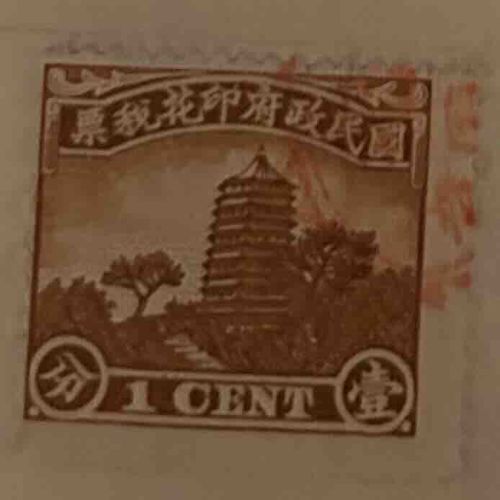
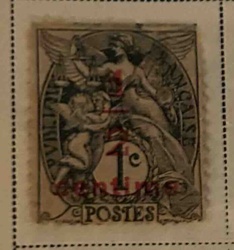
The item depicted is a revenue stamp from the Republic of China, featuring a prominent image of a multi-tiered pagoda. The stamp's primary colors are shades of brown, indicative of its age and the printing techniques commonly used for such items. The overall design is rectangular with perforated edges, typical of postage or revenue stamps of the era. At the top of the stamp, Chinese characters are visible, likely indicating the issuing authority, 'Republic of China Government Printing' or similar phrasing relating to its revenue purpose. The central motif is a detailed illustration of a traditional Chinese pagoda, rendered in a somewhat stylized yet recognizable manner. The pagoda appears to be situated on a hillside or elevated ground, flanked by trees or foliage. Below the central image, the denomination '1 CENT' is clearly printed in English, alongside corresponding Chinese characters for the value, '壹分' (Yi Fen, or one cent). A circular emblem containing a Chinese character is located on the bottom left, and another on the bottom right. The condition of the stamp shows some signs of wear, including slight discoloration and what appears to be part of an ink cancellation mark on the upper right, suggesting it was used. The perforations around the edges are mostly intact but show some small irregularities reflecting its age and handling. This stamp likely dates from the early to mid-20th century, a period of significant philatelic output from the Republic of China. The craftsmanship appears standard for revenue stamps of this period, with fine line work in the pagoda illustration and clear text.
AI Appraisal Report
Based on my visual examination of the provided image, this Republic of China revenue stamp, featuring a pagoda design and a '1 CENT' denomination, appears to be an authentic example from the early to mid-20th century. The printing style, color palette (shades of brown), and perforation pattern are consistent with stamps issued during that era. The presence of both English and Chinese characters for denomination ('1 CENT' and '壹分') further supports its authenticity as a Republic of China issue. The condition, while showing signs of age, including slight discoloration and what appears to be part of an ink cancellation mark on the upper right, is within the expected range for a used stamp of this vintage. The perforations, though showing minor irregularities, are largely intact. This cancellation suggests it fulfilled its intended purpose as a revenue stamp.
In terms of market conditions, Republic of China revenue stamps vary widely in value depending on rarity, denomination, condition, and specific issue. This particular pagoda design is relatively common, especially in lower denominations like '1 CENT.' Comparables for used examples in good but not pristine condition typically range from $5 to $50, with unused or exceptionally well-preserved examples fetching more. The visible cancellation mark, while confirming usage, also means it's not a pristine 'mint' example.
Factors impacting its value include its common denomination and the visible wear. While there is a steady collector demand for early Republic of China philatelic material, this specific issue in this condition is generally not considered rare.
Limitations: It is crucial to note that this appraisal is based solely on visual assessment from an image. Full authentication would necessitate in-person examination to verify paper type, watermark (if any), printing methods, and the precise nature of the cancellation. Examination under magnification could reveal hidden flaws or alterations. Ideally, a physical inspection would also confirm the stamp's gum condition (if unused) and rule out any repairs not visible in the photograph.