AI estimate as of November 9, 2025 · verify with a professional before acting
AI-Generated · Verify before acting
Everything on this page is generated by AI for informational purposes only. AI can make mistakes — the AI may misidentify items or misattribute them (artist, maker, brand, designer, origin, era). This is not an official valuation and should not be used for insurance, sale, tax, estate, legal, or lending purposes — or any decision requiring a certified appraisal. It is not an authoritative claim about any person, brand, or rights holder — do not share or rely on it as a factual statement about a third party. Always consult qualified professionals before making financial decisions.
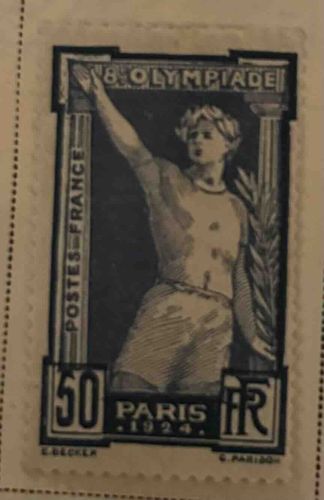
This is a rectangular postage stamp, primarily in shades of gray and white, featuring a design commemorating the 1924 Paris Olympic Games. The central image depicts a classical-style male figure, apparently an athlete, with a muscular physique, head crowned with a laurel wreath, and one arm raised in a gesture of salutation or victory. He appears to be wearing a simple loincloth. Flanking the figure are two classical columns, suggesting an ancient Greek or Roman architectural influence. On the left side of the stamp, running vertically, is the text "POSTES-FRANCE". Across the top, the inscription reads "VIII OLYMPIADE". At the bottom left, the denomination "50" is clearly visible, likely indicating 50 centimes. To its right, the word "PARIS" is prominently displayed, with the year "1924" underneath, confirming the event and location. On the bottom right, the stylized letters "RF" (République Française) are present. Below the main design, faintly visible, are the names "E. BECKER" and "G. PARISOT", likely the engraver and designer, respectively. The stamp exhibits perforation marks along its edges, though not perfectly aligned in the image, suggesting it may have been torn from a sheet. The overall condition appears to be good for its age, with no apparent major tears or significant creasing, although there is some slight discoloration consistent with age. This stamp represents a specific historical event and serves as a piece of philatelic history, showcasing the artistic and commemorative practices of early 20th-century French postal services.
AI Appraisal Report
I have visually examined the provided image of the France 1924 Paris Olympics 50c Postage Stamp. The stamp appears to be authentic based on the discernible design elements, inscriptions (VIII Olympiade, POSTES-FRANCE, 50, PARIS 1924, RF, E. BECKER, G. PARISOT), and typical printing characteristics of the period. The condition, from the image, seems to be fine to very fine, with good centering for its type, clear perforations, and no obvious major tears or creases. There is some slight, even toning consistent with its age, which is expected and does not significantly detract from its value. The design is well-preserved, and the details are sharp.
This stamp is a common and popular issue among Olympic and French philately collectors. While it commemorates a significant historical event, its production quantity was substantial. Market conditions for this specific issue are relatively stable, with consistent but not exceptionally high demand. Its rarity is low; copies are readily available through dealers and at auctions.
Factors impacting its value include the commonality of the issue. While the condition appears good, without a physical examination, I cannot definitively assess factors such as gum condition (mint vs. Hinged), any hidden imperfections, or subtle repairs. Imperfections like thinning, creases, or repairs, which are difficult to spot in an image, would significantly lower the value. For a full authentication and definitive condition assessment, an in-person examination by a professional philatelist is crucial. This would allow for examination of the gum, paper type, and micro-printing details under magnification, as well as verification against known forgeries.