These notes were written by the person who submitted this item. Appraiser.AI has not verified them, and the AI's identification and estimate may rely on them.
AI Estimated Value
Not an official valuation
$10 - $20
AI estimate as of November 9, 2025 · verify with a professional before acting
AI-Generated · Verify before acting
Everything on this page is generated by AI for informational purposes only. AI can make mistakes — the AI may misidentify items or misattribute them (artist, maker, brand, designer, origin, era). This is not an official valuation and should not be used for insurance, sale, tax, estate, legal, or lending purposes — or any decision requiring a certified appraisal. It is not an authoritative claim about any person, brand, or rights holder — do not share or rely on it as a factual statement about a third party. Always consult qualified professionals before making financial decisions.
This analysis also relies on unverified notes provided by the user, which may be incomplete or inaccurate and could affect the result.
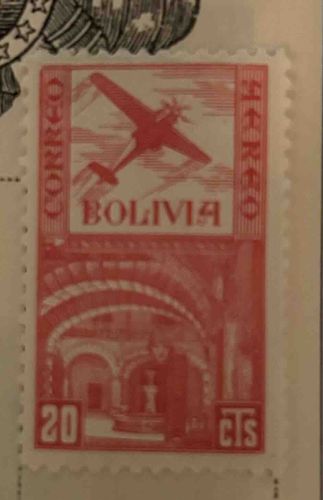
This item is a vintage Bolivian airmail postage stamp, designed with an oblong rectangular shape and a perforated edge typical of postal issues. The primary color visible is a reddish-pink or salmon hue, indicating it might be a 20 centavos (CTS) denomination. The stamp's design is vertically split into two main sections. The upper section prominently features a single-engine propeller airplane in flight, depicted mid-air with some vapor trails suggesting motion. Below the airplane, the country name 'BOLIVIA' is clearly inscribed in a bold, sans-serif font. The term 'CORREO' is vertically aligned on the left side of this upper section, while 'AEREO' is vertically aligned on the right, indicating its airmail purpose. The lower, larger section of the stamp displays an architectural scene, likely an interior view, characterized by a series of arched passageways and a central fountain or statue. The perspective suggests a courtyard or cloister setting. In the bottom left corner of this lower section, the numeral '20' is visible, and 'CTS' (cents) is in the bottom right, denoting the stamp's value. The overall condition appears good, with clean perforations and no immediate visible tears, creases, or heavy cancellations. The printing quality seems consistent with governmental postal issues of the mid-20th century. The stamp appears to be unmounted or lightly mounted, given the absence of hinge remnants or heavy cancellation marks over the central design. The color saturation is fairly uniform, and the design elements are sharply defined.
AI Appraisal Report
Based on my visual examination of the Bolivian Cents Airmail Stamp, the item appears to be authentic with characteristics consistent with government postal issues from the mid-20th century. The oblong rectangular shape, perforated edges, and the reddish-pink/salmon hue for the 20 Centavos denomination are all as expected. The printing quality seems sharp, and the design elements, including the airplane, 'BOLIVIA', 'CORREO AEREO', and the architectural scene with the ‘20 CTS’ denomination, are all clearly delineated. The perforations appear clean, and there are no immediate visible tears, heavy creases, or major cancellation marks that would significantly detract from its value. The color saturation is uniform, suggesting good preservation. It appears to be unmounted or lightly mounted, which contributes positively to its condition.
In terms of market conditions, Bolivian airmail stamps of this era are generally not considered rare. Demand is moderate, primarily from specialized Latin American philatelists. While its condition is good, which enhances its appeal, comparable sales for similar unfranked, good-condition examples of this specific issue typically fall within a modest range. Factors impacting value include the stamp's commonality and the fact that while attractive, it's not a top-tier rarity in the philatelic world.
It is crucial to note the limitations of appraising from images alone. While everything appears consistent with an authentic stamp, a definitive authentication would require an in-person examination. This would allow for a precise inspection of paper type, watermarks (if any), gum condition, and cancellation characteristics (if present). Examination under magnification can reveal subtle printing errors or characteristics that distinguish fakes or reprints. Provenance documentation, such as where and when the stamp was acquired, would also bolster authenticity. Without physical inspection, I cannot offer a 100% guarantee of authenticity, but visually, it appears to be a genuine example in good, collectible condition example.