AI estimate as of September 14, 2025 · verify with a professional before acting
AI-Generated · Verify before acting
Everything on this page is generated by AI for informational purposes only. AI can make mistakes — the AI may misidentify items or misattribute them (artist, maker, brand, designer, origin, era). This is not an official valuation and should not be used for insurance, sale, tax, estate, legal, or lending purposes — or any decision requiring a certified appraisal. It is not an authoritative claim about any person, brand, or rights holder — do not share or rely on it as a factual statement about a third party. Always consult qualified professionals before making financial decisions.
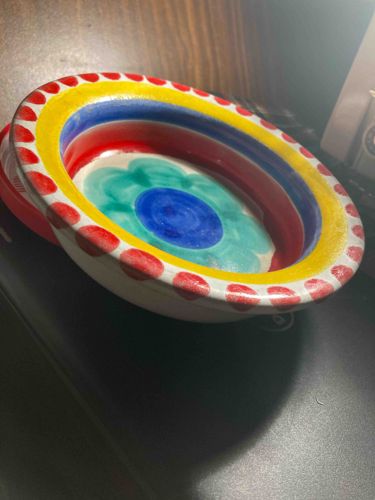
This item is a decorative ceramic bowl, likely crafted from earthenware or similar pottery, featuring vibrant, hand-painted designs. The bowl exhibits a shallow, wide form with a slightly flared rim. Its primary color scheme is bright and multi-hued, suggesting a folk art or a majolica-inspired aesthetic. The exterior of the bowl appears to be a light, possibly off-white, ceramic base. The interior is richly decorated, commencing with a distinct pattern around the rim: a yellow band closest to the edge, followed by a bold blue band, and then a striking red band, all applied with a somewhat rustic, brush-stroke quality. The outermost yellow band on the rim is further embellished with a repetitive pattern of red polka dots. The center of the bowl features a stylized floral or medallion motif composed of various colors. A central blue circle is surrounded by a light green, undulating shape, possibly representing petals, which is further bordered by a darker teal or blue-green outline. The brushwork throughout the piece appears expressive and somewhat uneven, indicative of hand-painting rather than mass-produced precision. Visible condition issues include some minor irregularities in the paint application and glaze, which are typical for hand-crafted ceramic pieces of this style and may not necessarily be considered damage but rather part of its artisanal character. There are no obvious chips, cracks, or repairs visible from the provided image. The glaze appears glossy, suggesting it has been fired. Without a visible maker's mark or signature, pinpointing the exact manufacturer or artist is difficult. However, the style strongly suggests Southern European, possibly Italian or Spanish, influences, characteristic of traditional majolica or similar earthenware traditions. Its estimated age would likely be mid-20th century to contemporary, given the vibrancy of the colors and the artistic style, though a precise determination would require further examination. The craftsmanship, while not perfectly uniform, indicates a deliberate artistic hand and an emphasis on decorative impact.
AI Appraisal Report
Based on my visual examination of the provided image, this hand-painted ceramic bowl is consistent with a decorative piece influenced by Majolica or similar Southern European earthenware traditions. The vibrant, multi-hued palette and hand-painted, somewhat rustic brushwork strongly suggest a mid-20th century to contemporary origin. The condition appears to be very good; I observe no obvious chips, cracks, or repairs. Minor irregularities in paint application and glaze are present but are characteristic of handcrafted items of this style and do not detract from its artistic intent or value.
In terms of market conditions, items of this decorative nature typically appeal to buyers looking for folk art, global decor, or Majolica-style pieces. While there is a steady demand for such items, they are not exceedingly rare, especially when lacking definitive maker's marks or provenance. Comparable pieces without specific artist attribution or historical significance generally sell in the lower to mid-range for decorative ceramics. Factors impacting value include its decorative appeal, lack of damage, and the artisanal quality. However, without a visible signature or maker's mark, authentication to a specific region, workshop, or artist is impossible from images alone. An in-person examination would allow me to assess the weight, tactile quality of the glaze, precise ceramic body, and search for any faint marks not visible in the photo. Chemical analysis of the glazes could potentially narrow down its origin or age. Without such verification, its value remains as a charming decorative piece rather than a collectible antique with documented provenance.