Mid-Century Modern Footed Ceramic Planter with Splatter Glaze
Vintage Ceramics and Pottery

Mid-Century Modern Footed Ceramic Planter with Splatter Glaze

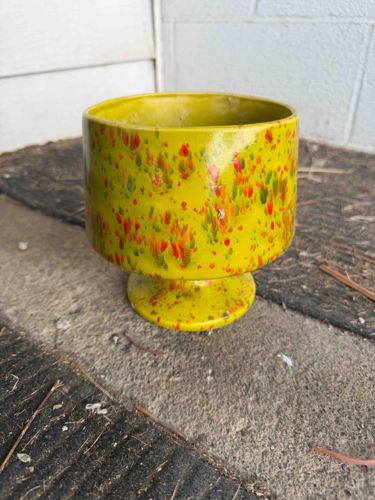
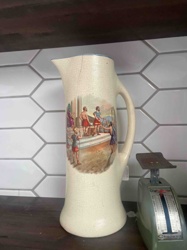
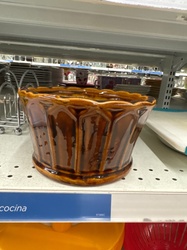
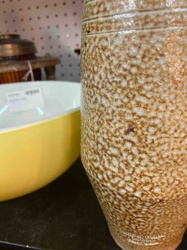
This is a vintage footed ceramic planter, commonly associated with Mid-Century Modern American pottery, likely dating from the 1960s to 1970s. The piece features a cylindrical body with slightly rounded shoulders, supported by a short, flared pedestal base. The physical construction consists of molded earthenware or stoneware covered in a vibrant mustard-yellow base glaze. Over the base color, it displays a distinctive 'splatter' or 'drip' glaze technique incorporating flecks of avocado green and burnt orange (or tomato red), creating a textured, organic visual pattern reminiscent of the 'pop art' and earth-tone aesthetics of the era. The interior appears to be finished with a similar yellow glaze. Condition-wise, the item shows visible signs of age and utility; there are several notable chips along the rim where the white ceramic body is exposed, as well as a significant chip on the side of the main vessel. Minor surface abrasions and pitting are present in the glaze finish. The pedestal base shows some light staining at the contact point with the ground. While no maker's mark is visible in this view, the style is highly characteristic of North American manufacturers like McCoy, Royal Haeger, or Hull, which produced mass-market decorative pottery for mid-century households. The heavy application of the secondary glaze colors suggests a studio-industrial hybrid style aimed at providing unique, non-uniform finishes on mass-produced forms.
Estimated Value

$45.00 - $65.00

Basic Information

Category

Vintage Ceramics and Pottery

Appraised On

February 17, 2026

Estimated Value

$45.00 - $65.00

Item Description

This is a vintage footed ceramic planter, commonly associated with Mid-Century Modern American pottery, likely dating from the 1960s to 1970s. The piece features a cylindrical body with slightly rounded shoulders, supported by a short, flared pedestal base. The physical construction consists of molded earthenware or stoneware covered in a vibrant mustard-yellow base glaze. Over the base color, it displays a distinctive 'splatter' or 'drip' glaze technique incorporating flecks of avocado green and burnt orange (or tomato red), creating a textured, organic visual pattern reminiscent of the 'pop art' and earth-tone aesthetics of the era. The interior appears to be finished with a similar yellow glaze. Condition-wise, the item shows visible signs of age and utility; there are several notable chips along the rim where the white ceramic body is exposed, as well as a significant chip on the side of the main vessel. Minor surface abrasions and pitting are present in the glaze finish. The pedestal base shows some light staining at the contact point with the ground. While no maker's mark is visible in this view, the style is highly characteristic of North American manufacturers like McCoy, Royal Haeger, or Hull, which produced mass-market decorative pottery for mid-century households. The heavy application of the secondary glaze colors suggests a studio-industrial hybrid style aimed at providing unique, non-uniform finishes on mass-produced forms.
Get Your Items Appraised

Instant estimates of your treasures with AI-powered instant appraisals

Browse More Appraisals