AI Appraisal Estimate

AI-generated estimates · not official valuations

From the user

What was submitted

Photo and notes provided by the user — not generated by AI

Submitted item photo
Submitted photo · July 11, 2026

User's notes

LAMAS pitcher Made in Italy

AI analysis below

AI appraisal

AI analysis & estimate

AI-Generated · Verify before acting

Everything below is generated by AI for informational purposes only. AI can make mistakes — the AI may misidentify items or misattribute them (artist, maker, brand, designer, origin, era). This is not an official valuation and should not be used for insurance, sale, tax, estate, legal, or lending purposes — or any decision requiring a certified appraisal. It is not an authoritative claim about any person, brand, or rights holder — do not share or rely on it as a factual statement about a third party. Always consult qualified professionals before making financial decisions.

Note

This analysis also relies on unverified notes provided by the user, which may be incomplete or inaccurate and could affect the result.

Read the full disclaimer

AI Identification

·Not independently authenticated·Verify before acting

Italian-style hand-painted ceramic pitcher

Ceramics and Pottery

AI Estimated Value

·Not an official valuation·Verify before acting

$45 - $85

As of July 11, 2026

AI Item Analysis

·AI can make mistakes·Verify before acting
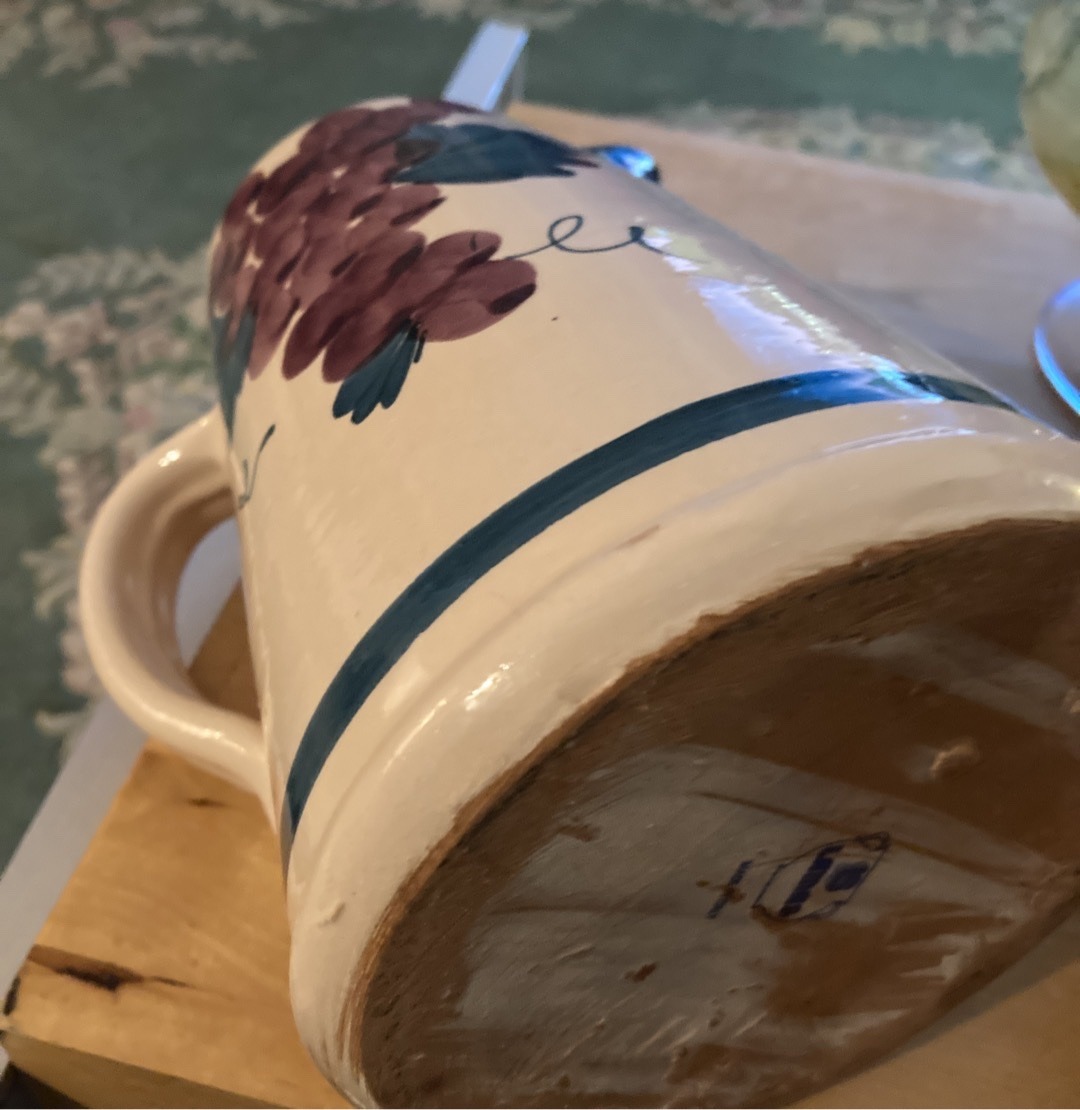
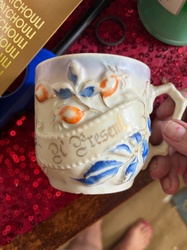
This ceramic pitcher appears to be a hand-painted piece of majolica or talvera-style earthenware. The vessel features a cream-colored glazed body decorated with a motif of purple/burgundy grapes and teal-green leaves, accented by a deep blue band near the base. It has a tapered cylindrical form with a simple curved handle. The base is unglazed, showing a reddish-brown clay body consistent with Italian terracotta manufacture. A blue mark is visible on the bottom which appears to contain a crest or symbolic graphic along with handwritten-style text; however, the mark is partially obscured by glaze drips and camera angle and cannot be definitively read. The owner identifies this as a 'LAMAS pitcher Made in Italy', a claim consistent with the visible rustic craftsmanship and the style of the bottom mark, though this attribution remains unverified without a clear, legible maker's signature and physical inspection. The condition shows some unevenness in the glaze application and surface texture typical of artisan production, along with some staining or residue on the unglazed bottom surface. The aesthetic is stylistically consistent with late 20th-century Italian decorative pottery.
AI Appraisal Report

·AI can make mistakes·Verify before acting
Based on the provided imagery, I have examined this ceramic pitcher, which appears to be a work of Italian majolica-style earthenware. The vessel features hand-painted grape motifs and a reddish-brown terracotta base consistent with Mediterranean artisan production from the late 20th century. Per user submission, the item is attributed to 'LAMAS' and identified as being made in Italy. While a blue mark is visible on the underside, I cannot definitively read the text or crest due to glaze drips and image resolution; therefore, its origin remains a working hypothesis. From what I can see, the glaze shows minor irregularities typical of hand-crafted pottery, though I cannot verify the presence of chips or internal stress cracks without a physical inspection. This value estimate assumes the owner's attribution to LAMAS is accurate. In the current secondary market, decorative Italian pottery of this type enjoys moderate demand as functional kitchenware or rustic decor. The estimated range of $45 to $85 reflects typical prices for mid-tier Italian import ceramics. If this item were found to be a mass-produced reproduction or from a less-collectible region, the value would likely decrease to the $15–$25 range. Conversely, providing provenance or obtaining an in-person expert verification of the maker's mark could support the higher end of the estimate. To establish a more precise valuation, a physical examination would be necessary to assess the glaze stability and identify the specific studio signature.

Related Tags

Explore similar items and categories

Get your items appraised

Instant estimates of your treasures with AI-powered appraisals

Browse More Appraisals