AI estimate as of September 22, 2025 · verify with a professional before acting
AI-Generated · Verify before acting
Everything on this page is generated by AI for informational purposes only. AI can make mistakes — the AI may misidentify items or misattribute them (artist, maker, brand, designer, origin, era). This is not an official valuation and should not be used for insurance, sale, tax, estate, legal, or lending purposes — or any decision requiring a certified appraisal. It is not an authoritative claim about any person, brand, or rights holder — do not share or rely on it as a factual statement about a third party. Always consult qualified professionals before making financial decisions.
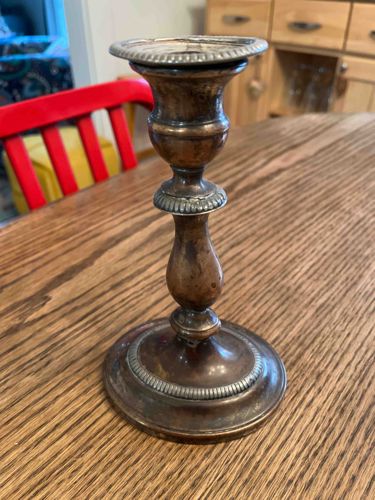
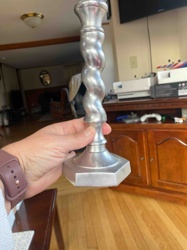
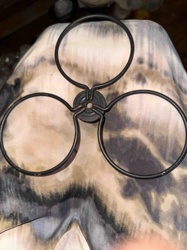
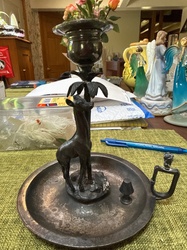
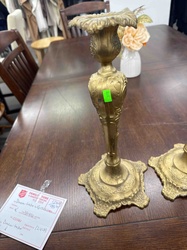
This item is an antique candlestick, likely crafted from brass, featuring a classic design often associated with 18th to early 20th-century decorative arts. The candlestick presents a tarnished, aged appearance with a rich, dark brown patina that suggests significant age and exposure. The base is circular and flares outwards, incorporating a decorative ring with a reeded or fluted pattern around its edge. The central shaft rises from the base with a distinct bulbous turn, leading to a narrower section, and then expands again to form a second decorative ring, also with a reeded pattern, before tapering upwards to the candle cup. The candle cup itself has a flaring rim that is wider than the base of the cup, and it also appears to have some decorative elements around its circumference, possibly similar reeding or a gadrooned edge, though less distinct due to wear and tarnish. The uppermost rim of the candle cup appears to be a lighter, more silvery tone, which could indicate a different metal, a silver plating that has worn significantly, or simply a difference in polishing or wear over time. There are no clear maker's marks or signatures visible from the provided image. The overall condition shows signs of substantial use and age, including surface scratches, pitting, and a heavily oxidized patina. The craftsmanship appears solid and functional for its intended purpose, reflecting traditional metalworking techniques of the era. The stylistic elements suggest it could be from a Neoclassical, Georgian, or Victorian period, given the traditional turned forms and reeded embellishments.
AI Appraisal Report
Upon visual examination of the provided image, this antique brass candlestick exhibits characteristics consistent with 18th to early 20th-century decorative arts. The rich, dark brown patina and surface wear, including scratches and pitting, strongly suggest authentic age and substantial use rather than artificial aging. The classic turned forms, bulbous turns, and reeded decorative bands are typical of Georgian, Neoclassical, or early Victorian designs. The apparent solid craftsmanship supports its functionality as an intended piece from that period.
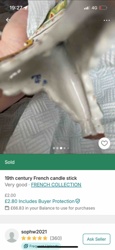
Market conditions for antique brass candlesticks are generally stable, with demand for well-preserved examples. However, un-attributed brass items are not exceptionally rare. Comparable items of similar age and style, lacking definitive maker’s marks, typically command prices in the low to mid-hundreds. The lack of a specific maker's mark significantly impacts its value, as signed or attributed pieces from notable foundries or designers would command considerably higher prices. The potential silvering on the candle cup rim is interesting but, without closer inspection, difficult to verify and does not significantly alter the valuation.
My assessment of authenticity is based solely on the visual cues from the image. For full authentication, an in-person examination would be crucial to assess the weight, method of construction (e.g., casting seams), alloy composition (through XRF analysis if necessary), and to search for obscured maker's marks. Documentation of provenance, tracing its ownership history, would also be invaluable for confirming its age and origin. Without these, my valuation remains an informed estimate based on typical market performance for comparable unsigned items.