AI estimate as of September 27, 2025 · verify with a professional before acting
AI-Generated · Verify before acting
Everything on this page is generated by AI for informational purposes only. AI can make mistakes — the AI may misidentify items or misattribute them (artist, maker, brand, designer, origin, era). This is not an official valuation and should not be used for insurance, sale, tax, estate, legal, or lending purposes — or any decision requiring a certified appraisal. It is not an authoritative claim about any person, brand, or rights holder — do not share or rely on it as a factual statement about a third party. Always consult qualified professionals before making financial decisions.
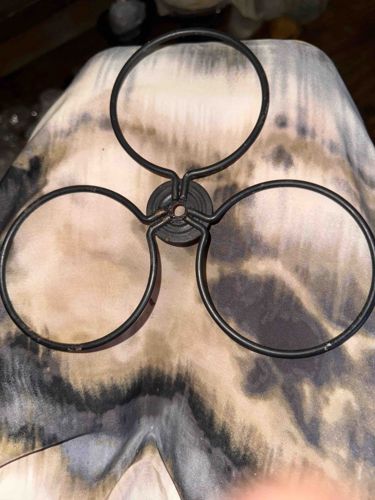
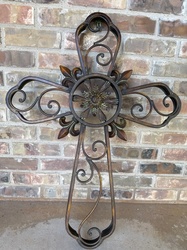
This item is a vintage three-ring candlestick holder, likely designed to hold slender taper candles. It is constructed entirely from black-painted metal, possibly wrought iron or a similar sturdy alloy, suggesting a robust and durable build. The design features three circular rings, each appearing to be approximately 3 to 4 inches in diameter, arranged in a triangular configuration around a central circular hub. The rings are formed from thin, uniform metal rods. From the central hub, three curved metal arms extend outwards to connect to each ring, providing structural support and defining the tri-circular shape. The central hub itself is a flat, disk-like piece, also made of black metal, with a small central opening, which might have been used for mounting or as a decorative element. The construction appears to be riveted or welded at the connection points between the arms and the rings, indicating a solid, integrated design. The black paint shows some signs of wear, particularly on the edges of the rings and the central hub, revealing faint hints of the underlying metal. There are no obvious maker's marks or signatures visible from the provided images. The style points towards a mid-20th-century aesthetic, possibly 1950s to 1970s, characterized by its minimalist lines and functional design. The overall condition appears good for its age, with expected minor scuffs and paint loss, contributing to a desirable vintage patina rather than significant damage. The craftsmanship seems utilitarian but effective, focusing on stability and form. Its unique three-ring configuration makes it a distinctive decorative piece.
AI Appraisal Report
This vintage three-ring candlestick holder presents as a charming mid-20th-century decorative piece. Based on the visual examination, the condition appears good for its age, showcasing expected wear such as minor scuffs and paint loss on the black-painted metal, which I consider to contribute to a desirable vintage patina rather than detracting significantly from its appeal. The construction, likely welded or riveted, suggests a robust build, consistent with similar items from the 1950s-1970s. The absence of visible maker's marks is common for many utilitarian decorative items from this period.
From a market perspective, demand for unique vintage home decor, especially candlestick holders with distinctive designs, remains consistent. While not exceedingly rare, its specific three-ring configuration sets it apart from more common single or multi-stick designs. Comparable black metal vintage candlestick holders of similar size and age typically retail in the $30-$80 range, with more unique designs commanding the higher end. Factors impacting its value positively include its overall good, solid condition and its unique, aesthetically pleasing design. The utilitarian craftsmanship, while effective, prevents it from reaching higher collectible values associated with artisanal or signed pieces.
It is important to note that my assessment of authenticity and material is based solely on the provided images. A physical inspection would allow for a definitive determination of the metal type, the exact nature of the construction (e.g., weld quality, rivet type), and a more precise evaluation of wear. Additionally, while no marks are visible, an in-person examination might uncover subtle manufacturing details or remnants of labels. Provenance documentation, if available, could further enhance its value, but is unlikely for an item of this type and value range.