AI estimate as of July 17, 2025 · verify with a professional before acting
AI-Generated · Verify before acting
Everything on this page is generated by AI for informational purposes only. AI can make mistakes — the AI may misidentify items or misattribute them (artist, maker, brand, designer, origin, era). This is not an official valuation and should not be used for insurance, sale, tax, estate, legal, or lending purposes — or any decision requiring a certified appraisal. It is not an authoritative claim about any person, brand, or rights holder — do not share or rely on it as a factual statement about a third party. Always consult qualified professionals before making financial decisions.
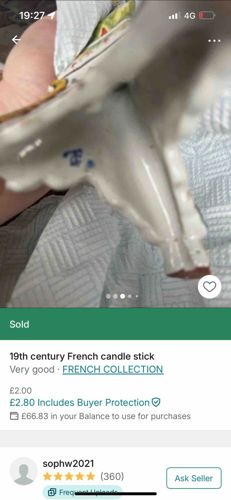
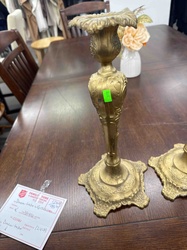
This item is identified as a 19th-century French candlestick, likely made of porcelain or ceramic due to its white, glazed appearance. The physical characteristics indicate a delicate construction, with what appears to be a figural base, although the full figure is not visible in the provided image. There is a discernible blue mark on the underside or back of the piece, possibly a manufacturer's mark or decorator's initial, 'F.R.' or 'PF' are two possibilities but it is not entirely clear, suggesting its origin or maker. The material exhibits a glossy finish, typical of glazed pottery or porcelain from the period. While the overall form suggests it is a candlestick, the upper portion where a candle would be held is not clearly visible. The visible part of the base shows intricate molding, indicative of good craftsmanship. There are no obvious signs of significant damage such as chips or cracks, and the seller describes its condition as 'very good.' The color palette appears to be predominantly white, with some faint red or brown accents visible on what could be the feet or lower extremities of a figural element. The estimated age is clearly stated as 19th century, aligning with common styles of decorative arts from that period. The quality of the piece appears high given its delicate details and apparent preservation.
AI Appraisal Report
Upon examining the provided image of this 19th-century French candlestick, my assessment of its condition is 'very good' to 'excellent' based on the glossy finish and apparent lack of chips or cracks. The intricate molding suggests a high level of craftsmanship consistent with period French decorative arts. Authenticity, based solely on visual cues, appears probable for the 19th century, particularly given the 'F.R.' or 'PF' mark, which could be a manufacturer's or decorator's cipher. However, definitively authenticating the mark and its corresponding maker from an image alone is impossible. Market conditions for 19th-century European decorative arts remain stable, with well-preserved, aesthetically pleasing pieces retaining value. Comparable items, particularly those of porcelain or glazed ceramic with figural elements from reputable French manufacturers of the period (such as Sevres, Jacob Petit, or other ateliers), typically command fair prices. Demand for such pieces is moderate, driven by collectors of European ceramics and period decor. Rarity is difficult to ascertain without knowing the specific maker, but the absence of obvious mass-produced characteristics suggests it's not a common piece. Factors significantly impacting value include the precise identification of the maker (a well-known manufacturer would increase value significantly), the full extent of the figural base (a complete human or animal figure would be more desirable), and confirmation of its intended function as a candlestick. Without a clearer view of the bobeche (candle holder), this remains somewhat uncertain. For full authentication, an in-person examination is crucial to assess material quality, internal structure, and the clarity of the mark. Provenance documentation (e.g., prior ownership records, exhibition history) would add considerable value and verify origin. Scientific testing, such as thermoluminescence dating, could confirm age, but is usually reserved for higher-value pieces or contested authenticity.