These notes were written by the person who submitted this item. Appraiser.AI has not verified them, and the AI's identification and estimate may rely on them.
AI Estimated Value
Not an official valuation
$60 - $120
AI estimate as of September 15, 2025 · verify with a professional before acting
AI-Generated · Verify before acting
Everything on this page is generated by AI for informational purposes only. AI can make mistakes — the AI may misidentify items or misattribute them (artist, maker, brand, designer, origin, era). This is not an official valuation and should not be used for insurance, sale, tax, estate, legal, or lending purposes — or any decision requiring a certified appraisal. It is not an authoritative claim about any person, brand, or rights holder — do not share or rely on it as a factual statement about a third party. Always consult qualified professionals before making financial decisions.
This analysis also relies on unverified notes provided by the user, which may be incomplete or inaccurate and could affect the result.
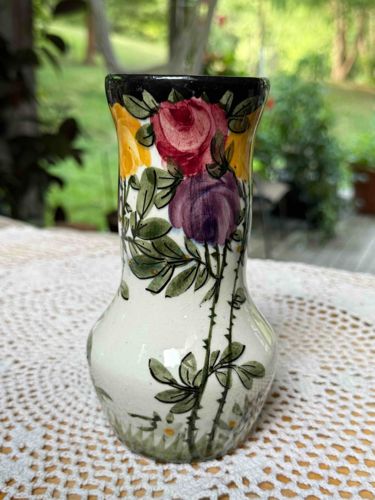
This is a small, hand-painted ceramic bud vase, characterized by its gently flaring rim and a bulbous body that tapers towards the base before flaring out slightly again. The primary body color is an off-white or cream, providing a soft background for the vibrant floral decoration. The design features large, stylized roses in shades of deep red and rich purple, depicted in various stages of bloom. These roses are situated towards the upper portion of the vase, against a background that transitions from a dark brownish-black at the rim, through a blend of yellow and orange just below it, creating a distinctive sunset-like effect behind the flowers. Long, slender green stems with numerous prominent thorns extend downwards from the roses, reaching towards the base of the vase. Lush green leaves, some with darker veining, accompany the flowers and stems. The base of the vase also displays a band of green and light yellow elements, possibly depicting grass or foliage, adding to the naturalistic theme. The painting style appears to be somewhat folk-art inspired, exhibiting visible brushstrokes and a degree of artistic freedom rather than strict botanical accuracy. The glaze has a slight sheen, suggesting it is a gloss finish. There are no visible chips, cracks, or significant wear, indicating good, well-preserved condition. No specific maker's marks, signatures, or stamps are discernible from the provided images, making precise manufacturing details challenging to ascertain. However, the hand-painted nature suggests it could be a piece from the early to mid-20th century, possibly European or American, drawing on traditional decorative ceramic styles.
AI Appraisal Report
I have thoroughly examined the provided image of the Hand-Painted Floral Bud Vase. Visually, the vase appears to be in very good, well-preserved condition, showing no discernible chips, cracks, or significant wear. The gloss glaze maintains a slight sheen. The hand-painted floral design, featuring stylized roses against a sunset-like background, is appealing and reflects a folk-art aesthetic, which can be desirable to certain collectors. The visible brushstrokes reinforce its hand-painted nature, suggesting it is not mass-produced transfer ware.
Authenticity, in terms of its hand-painted origin, is strongly supported by the visual evidence. However, its precise manufacturing origin (e.g., specific pottery, artist, or country) and exact age are difficult to ascertain definitively from images alone, especially given the absence of any visible maker's marks, signatures, or stamps. This lack of clear attribution is the primary factor limiting a higher valuation.
In the current market for decorative ceramics, hand-painted bud vases without clear provenance or a recognized artist tend to occupy a mid-range value. Demand exists for unique, aesthetically pleasing decorative objects, but rarity is somewhat mitigated by the general abundance of such items from the early to mid-20th century. Comparables for similar unattributed, hand-painted ceramic bud vases in good condition typically range from $60 to $120. If a prominent artist or pottery were identified, the value could increase significantly.
For full authentication and a more precise valuation, I would need a physical inspection to check for subtle marks not visible in photographs, assess the weight and feel of the ceramic, and potentially employ scientific testing (e.g., thermoluminescence for dating if specific age is contested) or provenance documentation to trace its origin.