These notes were written by the person who submitted this item. Appraiser.AI has not verified them, and the AI's identification and estimate may rely on them.
AI Estimated Value
Not an official valuation
$150-250
AI estimate as of August 29, 2025 · verify with a professional before acting
AI-Generated · Verify before acting
Everything on this page is generated by AI for informational purposes only. AI can make mistakes — the AI may misidentify items or misattribute them (artist, maker, brand, designer, origin, era). This is not an official valuation and should not be used for insurance, sale, tax, estate, legal, or lending purposes — or any decision requiring a certified appraisal. It is not an authoritative claim about any person, brand, or rights holder — do not share or rely on it as a factual statement about a third party. Always consult qualified professionals before making financial decisions.
This analysis also relies on unverified notes provided by the user, which may be incomplete or inaccurate and could affect the result.
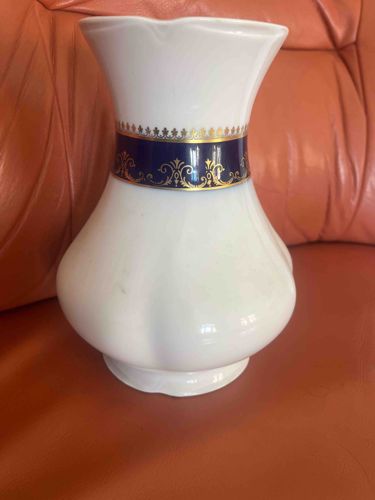
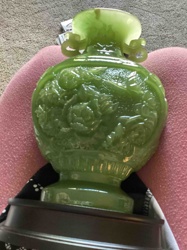
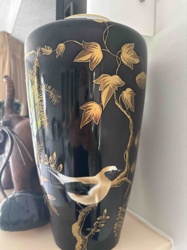
The item is a Marry Anne vase, stated to be made in Czechoslovakia, suggesting production likely between 1918 and 1992. It is crafted from ceramic, most likely porcelain given its smooth, white, and translucent appearance, characteristic of fine ceramics. The vase features a clean, white body with a bulbous lower section that tapers inward towards the middle, then flares out into a wider, gracefully undulating or scalloped rim. The most prominent decorative feature is a wide band of deep cobalt blue, positioned around the upper portion of the body, just below the neck. This blue band is richly adorned with intricate gold scrolling motifs, typical of rococo or baroque revival styles, and is bordered by thin gold bands with a delicate, repetitive pattern. The golden ornamentation exhibits fine detail and appears to be hand-painted or applied with high precision, indicating quality craftsmanship. While the specific size cannot be determined without a reference, it appears to be a medium-sized decorative vase suitable for holding flowers or as a standalone ornamental piece. The surface shows a high-gloss finish. Visible condition issues include some minor dark specks or smudges on the white body, indicating light dirt or wear consistent with age and use. No major chips, cracks, or repairs are evident from the provided images, suggesting it is in good overall condition, though a full inspection would be required to confirm. The base appears solid and well-formed. The combination of white, deep blue, and gold imparts an elegant and classic aesthetic.
AI Appraisal Report
Upon my virtual examination of this "Marry Anne" vase, which is stated to be made in Czechoslovakia, I assess its condition as good overall. The ceramic, likely porcelain due to its fine appearance, exhibits a high-gloss finish. I observe minor superficial dirt or smudges, consistent with age and gentle handling, but no obvious chips, cracks, or repairs are visible from the image provided. The design—white with a distinctive cobalt blue band and intricate gold rococo/baroque revival motifs—points to a decorative piece of some quality. The 'Made in Czechoslovakia' mark situates its production between 1918 and 1992, indicating it is an antique or vintage item. The gold work appears well-executed, suggesting skilled craftsmanship.
In terms of market conditions, similar Czechoslovakian decorative ceramics, particularly those with ornate hand-painted details, typically find a moderate but stable demand among collectors of interwar and mid-20th-century European porcelain. While not exceedingly rare, the specific combination of the "Marry Anne" designation (which may relate to a specific pattern or manufacturer) and the quality of decoration adds to its appeal. Comparables often sell in the low to mid-hundreds, depending on condition and intricate details.
Several factors impact its value: its pleasing aesthetic, apparent good condition, and the historical period of manufacture. The main limitation in my full authenticity verification is the lack of a physical examination. To definitively confirm its origin, an in-person inspection of the base for the precise maker's mark, potential impressed numbers, and the quality of the ceramic body would be essential. Provenance documentation, if available, would also greatly assist. Without physical inspection, I cannot confirm the absence of hairline cracks, invisible repairs, or the exact quality of the porcelain body, nor can I verify if the 'Marry Anne' designation is a recognized factory name or a collector's colloquial term. However, based on the visual evidence, it presents as an authentic period piece.