Sardinia 1854 Victor Emmanuel II 5 Centesimi Green Postage Stamp
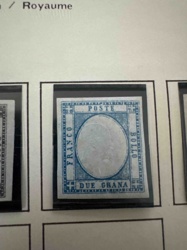
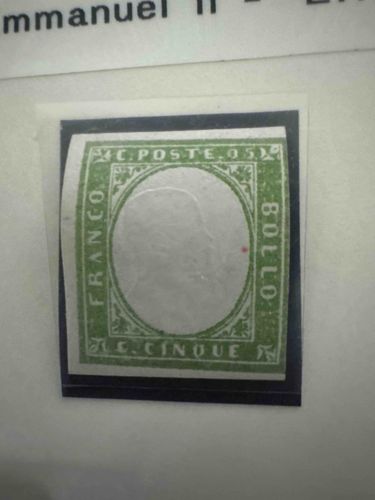
This is a philatelic specimen representing the 1854 issue of the Kingdom of Sardinia, featuring King Victor Emmanuel II. The stamp is printed in a distinctive myrtle-green ink on white paper. Its design consists of a central oval frame containing an embossed, colorless profile of the monarch facing right. The surrounding rectangular border is highly ornate with scrollwork corners and includes the inscriptions 'FRANCO' (left), 'BOLLO' (right), 'C. POSTE. 05.' (top), and 'C. CINQUE' (bottom). As an early 'imperforate' issue, it lacks standard perforations and has been hand-cut from a sheet. Physically, the stamp shows wide margins on the top and right, but the cut is tight on the left side, slightly encroaching on the design border. The embossing of the King's head remains visible but lacks sharp definition, indicating possible wear or a flat strike. There is a tiny red fiber or ink speck visible in the white oval area, likely a manufacturing fluke or minor environmental inclusion. The overall condition appears to be used or hinged, with no visible cancellation ink across the face, which is rare for this period. The craftsmanship reflects the mid-19th-century typography and embossing techniques used by the Francesco Matraire printing office in Turin.
AI-Generated Appraisal Disclaimer
Estimated Value
$450 - $650
Basic Information
Category
Philately / Rare Postage Stamps
Appraised On
March 18, 2026
Estimated Value
$450 - $650
Item Description
This is a philatelic specimen representing the 1854 issue of the Kingdom of Sardinia, featuring King Victor Emmanuel II. The stamp is printed in a distinctive myrtle-green ink on white paper. Its design consists of a central oval frame containing an embossed, colorless profile of the monarch facing right. The surrounding rectangular border is highly ornate with scrollwork corners and includes the inscriptions 'FRANCO' (left), 'BOLLO' (right), 'C. POSTE. 05.' (top), and 'C. CINQUE' (bottom). As an early 'imperforate' issue, it lacks standard perforations and has been hand-cut from a sheet. Physically, the stamp shows wide margins on the top and right, but the cut is tight on the left side, slightly encroaching on the design border. The embossing of the King's head remains visible but lacks sharp definition, indicating possible wear or a flat strike. There is a tiny red fiber or ink speck visible in the white oval area, likely a manufacturing fluke or minor environmental inclusion. The overall condition appears to be used or hinged, with no visible cancellation ink across the face, which is rare for this period. The craftsmanship reflects the mid-19th-century typography and embossing techniques used by the Francesco Matraire printing office in Turin.
Related Tags
Get Your Items Appraised
Instant estimates of your treasures with AI-powered instant appraisals