AI Appraisal Estimate

AI-generated estimates · not official valuations

From the user

What was submitted

Photo and notes provided by the user — not generated by AI

Submitted item photo
Submitted photo · June 16, 2026

User's notes

No additional notes provided.

AI analysis below

AI appraisal

AI analysis & estimate

AI-Generated · Verify before acting

Everything below is generated by AI for informational purposes only. AI can make mistakes — the AI may misidentify items or misattribute them (artist, maker, brand, designer, origin, era). This is not an official valuation and should not be used for insurance, sale, tax, estate, legal, or lending purposes — or any decision requiring a certified appraisal. It is not an authoritative claim about any person, brand, or rights holder — do not share or rely on it as a factual statement about a third party. Always consult qualified professionals before making financial decisions.

Read the full disclaimer

AI Identification

·Not independently authenticated·Verify before acting

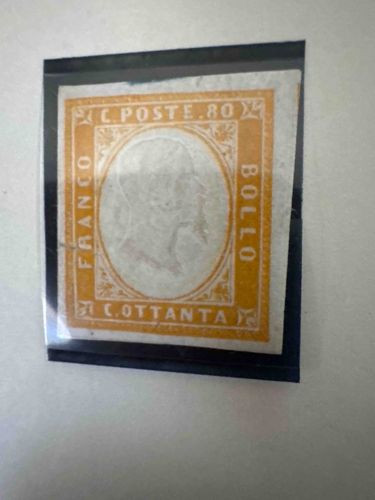
Sardinia 1861 80 Centesimi Yellow-Orange Postage Stamp

Philately / Rare Postage Stamps

AI Estimated Value

·Not an official valuation·Verify before acting

$450.00 - $650.00

As of June 16, 2026

AI Item Analysis

·AI can make mistakes·Verify before acting
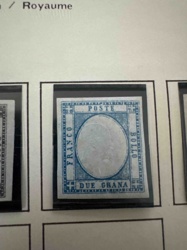
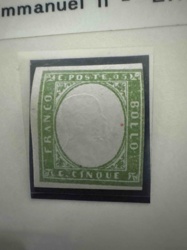
This item is a 19th-century postage stamp from the Kingdom of Sardinia (Italy), specifically the 1861 issue featuring the embossed profile of King Victor Emmanuel II. The stamp is printed in a yellow-orange to bistre-orange ink on white paper. Its design consists of an embossed central medallion with the King's head facing right, surrounded by an oval frame within a rectangular border. The border contains the inscriptions 'C. POSTE. 80' at the top, 'BOLLO' on the right, 'C. OTTANTA' at the bottom, and 'FRANCO' on the left side. Historically, this design was used before the full unification of Italy, marking a significant transitional period in European history (circa 1855-1863). The stamp is an imperforate specimen, which was typical for early Sardinian issues, meaning it was hand-cut from a sheet. Physically, the stamp shows uneven margins, which is a common characteristic of stamps cut with scissors during that era; the right margin appears significantly wider than the left. The condition of the embossing on the King's face appears somewhat flattened or worn, though still discernible. There are visible signs of aging on the paper, including minor toning and small dark inclusions, likely foxing or environmental surface dirt. No cancel mark is clearly visible, suggesting it may be an unused example, though further expert examination of the reverse (for original gum or lack thereof) would be required for a definitive grading. Small creases or edge wear are visible along the top and left sides. The item is currently housed in a protective black glassine or plastic mounting strip for preservation.
AI Appraisal Report

·AI can make mistakes·Verify before acting
I have conducted a visual examination of the Sardinia 1861 80 Centesimi Yellow-Orange postage stamp (Sassone No. 17D). This issue, featuring the embossed profile of King Victor Emmanuel II, represents the final definitive series for the Kingdom of Sardinia before the transition to the Kingdom of Italy. The specimen presented appears to be in unused condition without a visible cancellation. The yellow-orange pigmentation remains relatively vibrant, though the central embossing shows signs of compression typical of stored philatelic material of this age. The margins are uneven; the right side is ample, but the left and top margins are cut close to the design frame, which negatively impacts the grade. Visible foxing and surface toning suggest long-term exposure to varying humidity. While the stamp appears authentic based on the lithographic frame characteristics and embossing style, photographic analysis cannot confirm the presence of original gum (OG), which is the primary driver of value for unused 19th-century issues. Currently, the market for classic Italian States is stable but highly quality-dependent. Comparable examples with full margins and original gum can exceed $1,500, whereas 'no gum' or regummed examples trade significantly lower. The valuation of $450-$650 assumes a 'large part original gum' status with minor flaws. To finalize this appraisal, I would require a physical inspection to check for thins or repairs using a quartz lamp and to verify the paper's watermark and gum integrity. A certificate of authenticity from a recognized expert, such as Raybaudi or Bolaffi, would be necessary for any high-value transaction to verify that the embossing has not been artificially 're-pressed'.

Get your items appraised

Instant estimates of your treasures with AI-powered appraisals

Browse More Appraisals