AI estimate as of August 14, 2025 · verify with a professional before acting
AI-Generated · Verify before acting
Everything on this page is generated by AI for informational purposes only. AI can make mistakes — the AI may misidentify items or misattribute them (artist, maker, brand, designer, origin, era). This is not an official valuation and should not be used for insurance, sale, tax, estate, legal, or lending purposes — or any decision requiring a certified appraisal. It is not an authoritative claim about any person, brand, or rights holder — do not share or rely on it as a factual statement about a third party. Always consult qualified professionals before making financial decisions.
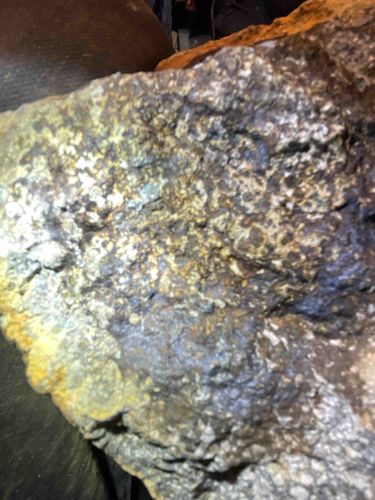
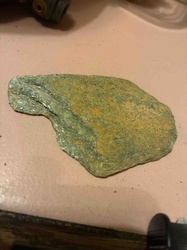
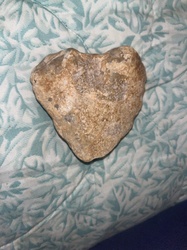
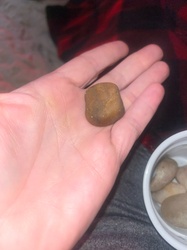
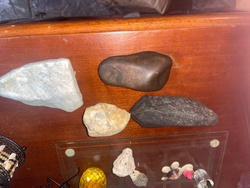
The item appears to be a natural rock or mineral specimen, characterized by a highly textured and irregular surface. Its coloration is varied, dominated by earthy tones including hues of brown, rust red, dark grey, and patches of lighter, almost white, crystalline or granular material. There are also distinct areas exhibiting a yellowish-green coloration, particularly towards the lower left portion of the image, which suggests the presence of oxidation or specific mineral inclusions. The overall texture is rough, possibly indicative of a conglomerate or a heavily weathered igneous/metamorphic rock. The surface shows a granular or pebbly structure with some areas appearing more massive and others more fragmented. No clear manufacturing details, such as makers' marks or signatures, are visible, strongly supporting its natural origin. The condition shows significant natural weathering and possibly some mineral deposits or efflorescence. The 'patina' observed is likely natural oxidation and mineral alteration over time. Given its appearance, it is difficult to assign a specific age beyond 'geological time', but its raw, unworked state suggests it has not been significantly altered by human hand. The quality indicators relate to its natural formation and compositional variety rather than craftsmanship.
AI Appraisal Report
Upon visual examination of the provided image, this specimen appears to be a natural geological formation with a highly textured and varied surface, displaying earthy tones of brown, red, dark grey, and patches of yellowish-green, indicative of mineral inclusions and oxidation. The rough, granular texture suggests it could be a conglomerate, heavily weathered igneous, or metamorphic rock. Its authenticity as a natural specimen is strongly supported by the lack of any man-made alterations or markings. The condition shows significant natural weathering and efflorescence, consistent with its natural formation over geological time.
Assessing market conditions for raw geological specimens like this requires understanding that value is often driven by aesthetic appeal, rarity, and the potential presence of specific, identifiable minerals. Without precise identification of the constituent minerals, especially the yellowish-green component, its specific market appeal is limited. Collectors of general rock specimens might find it interesting for its varied texture and coloration, but its value is more aligned with decorative or educational purposes rather than a rare mineral find.
Demand for such an unclassified specimen is relatively low compared to identified minerals or crystals. Its rarity is difficult to ascertain without knowing its precise geological origin and composition; many visually similar rocks exist globally. Factors impacting its value negatively include its unknown composition and the absence of clear, distinctive features that would appeal to specialized collectors. Positively, its natural varied aesthetic might attract amateur collectors or those seeking decorative pieces.
Limitations in authenticity verification are significant. While it appears genuinely natural, definitive mineral identification, geological classification, and confirmation of its origin cannot be made from images alone. A physical examination would allow for tactile assessment, hardness testing, streak testing, specific gravity measurement, and potentially acid tests. Furthermore, thin-section analysis, X-ray diffraction (XRD), or scanning electron microscopy (SEM) would be crucial for precise mineral identification and a deeper understanding of its petrology. Provenance documentation, though rare for raw specimens, would also add value if available. Without these, the appraisal remains largely speculative based on visual aesthetics.