AI Appraisal Estimate

AI-generated estimates · not official valuations

From the user

What was submitted

Photo and notes provided by the user — not generated by AI

Submitted item photo
Submitted photo · June 6, 2026

User's notes

No additional notes provided.

AI analysis below

AI appraisal

AI analysis & estimate

AI-Generated · Verify before acting

Everything below is generated by AI for informational purposes only. AI can make mistakes — the AI may misidentify items or misattribute them (artist, maker, brand, designer, origin, era). This is not an official valuation and should not be used for insurance, sale, tax, estate, legal, or lending purposes — or any decision requiring a certified appraisal. It is not an authoritative claim about any person, brand, or rights holder — do not share or rely on it as a factual statement about a third party. Always consult qualified professionals before making financial decisions.

Read the full disclaimer

AI Identification

·Not independently authenticated·Verify before acting

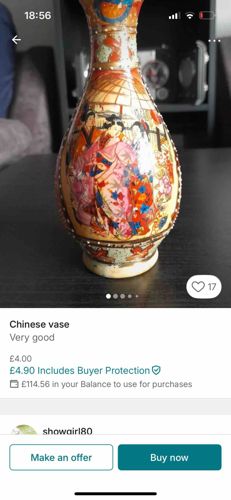
Decorative Chinese Figural Vase

Vase

AI Estimated Value

·Not an official valuation·Verify before acting

$40-80

As of June 6, 2026

AI Item Analysis

·AI can make mistakes·Verify before acting
This appears to be a decorative Chinese vase, likely made of ceramic or porcelain, given its smooth, glossy appearance and traditional painted motifs. The vase features a bulbous body that tapers upwards to a slender neck with a flared rim, a classic silhouette often seen in Asian ceramics. The dominant colors in the intricate design include vibrant reds, oranges, blues, and pinks, set against an off-white or yellowish background. The decoration prominently displays figures, possibly depicting court scenes or mythological narratives, alongside architectural elements such as roofs and structures, and stylized cloud patterns. There are also delicate patterns around the neck and base. A distinguishing feature is the raised, beaded texture or possibly applied faux jewels along vertical seams on the body, adding a three-dimensional and luxurious quality to the piece. While no visible maker's marks are discernible from the image, the style suggests it could be a modern decorative piece, perhaps from the late 20th or early 21st century, often produced for export or as souvenirs. The visible condition appears to be 'very good' as stated in the accompanying text, with no obvious chips, cracks, or significant paint loss. The overall craftsmanship suggests it's a mass-produced item rather than a unique, hand-painted antique, aiming for aesthetic appeal rather than historical accuracy. The specific style of painting and the addition of raised decorative elements are characteristic of certain decorative ceramics produced in China.
AI Appraisal Report

·AI can make mistakes·Verify before acting
Based on my visual examination of the provided image, this decorative Chinese figural vase appears to be in very good condition, aligning with the stated condition. There are no readily apparent chips, cracks, or significant paint loss. The colors remain vibrant. Authenticity-wise, the style, including the depiction of figures, architectural elements, and cloud motifs, combined with the raised beaded texture, strongly suggests this is a modern decorative piece, likely late 20th or early 21st century production. The aesthetic leans towards mass-produced items for export or souvenir markets, aiming for decorative appeal rather than antique status. This is not a rare item; similar decorative vases are commonly found in specialty home decor stores, online marketplaces, and import shops. Market conditions for such items prioritize decorative aesthetic over historical significance or unique craftsmanship. The demand is driven by individuals seeking colorful, ornate pieces to complement interior décor, rather than collectors seeking high-value antiques. Factors significantly impacting value include its mass-produced nature and lack of historical provenance. Its decorative rather than antique status limits its appraisal value. The primary limitation in authenticity verification from an image alone is the inability to assess the tactile quality of the materials (ceramic vs. porcelain), the true nature of the raised elements (beads vs. applied jewels), and the method of decoration (hand-painted vs. decal applications). A physical in-person examination would allow for tactile inspection, closer scrutiny of painting techniques, and the presence of any hidden marks or manufacturing indicators. Provenance documentation or scientific testing would be unnecessary for a modern decorative piece of this nature, as its value is not tied to antiquity or rare authorship.

Get your items appraised

Instant estimates of your treasures with AI-powered appraisals

Browse More Appraisals