AI estimate as of July 12, 2025 · verify with a professional before acting
AI-Generated · Verify before acting
Everything on this page is generated by AI for informational purposes only. AI can make mistakes — the AI may misidentify items or misattribute them (artist, maker, brand, designer, origin, era). This is not an official valuation and should not be used for insurance, sale, tax, estate, legal, or lending purposes — or any decision requiring a certified appraisal. It is not an authoritative claim about any person, brand, or rights holder — do not share or rely on it as a factual statement about a third party. Always consult qualified professionals before making financial decisions.
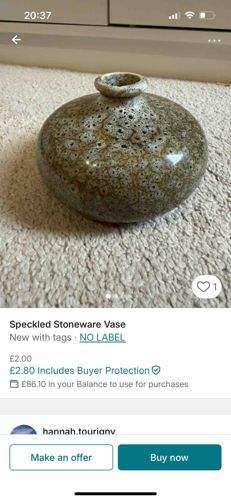
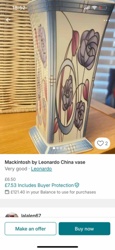
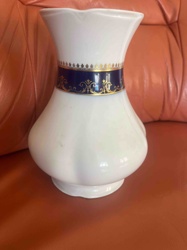
This is a globular stoneware vase, characterized by its distinctive speckled, crater-like glaze. The primary colors of the glaze appear to be varying shades of green, brown, and grey, with lighter, possibly off-white or yellowish tones creating the 'speckles' or 'craters,' and darker, more intense spots within the depressions giving it a mottled, organic texture reminiscent of volcanic rock or the surface of some natural stone. The overall form is ovoid or spherical, with a slightly flattened base and a short, narrow neck that flares minimally at the rim before continuing into the main body. The opening at the top is small and circular. The glaze has a glossy finish, reflecting light and emphasizing the textural variations. There are no visible chips, cracks, or significant damage in the provided image, suggesting good overall condition. The construction appears sturdy, indicating typical stoneware durability. Given the contemporary nature of the listing and the general aesthetic, it is likely a modern piece, possibly dating from the late 20th or early 21st century. No discernible maker's marks or signatures are visible, and the listing explicitly states 'NO LABEL.' The craftsmanship appears decent, with the glaze being the most notable decorative element, providing a unique and somewhat rustic appeal. The quality is indicative of mass-produced or studio pottery rather than fine art ceramics, but the glaze effect is well-executed.
AI Appraisal Report
Upon visual examination of the provided image, this speckled stoneware vase presents as a contemporary piece, likely late 20th to early 21st century. Its condition appears excellent, with no visible chips, cracks, or significant damage, suggesting it has been well-preserved or is relatively new. The distinctive speckled, crater-like glaze, resembling volcanic rock, is the primary aesthetic feature. While visually appealing, the 'NO LABEL' notation and absence of visible maker's marks, coupled with the general aesthetic, indicate it's likely a mass-produced or studio pottery item rather than a unique piece by a renowned ceramic artist. This significantly impacts its market value. The craftsmanship is decent, particularly the glaze application, providing a unique rustic appeal.
In terms of market conditions, stoneware vases of this type, without artist attribution, generally command modest prices. Comparable items in the contemporary pottery market often retail from independent craftspeople or smaller studios, or through online platforms. Demand for such pieces is steady but not high-end, appealing to those seeking decorative accents rather than investment pieces. Rarity is not a factor here; similar items, while varied in exact glaze, are commonly produced.
Factors limiting value include the lack of artist provenance, absence of age, historical significance, or exceptional artistry. Authenticity verification from images alone is severely limited; I cannot confirm the material composition, exact firing techniques, or the true origin without physical inspection. For full authentication, an in-person examination would allow for tactile inspection, detailed analysis of the ceramic body and glaze consistency, and a thorough search for any subtle marks. Provenance documentation or scientific testing (e.g., thermoluminescence for age) would be necessary for definitive authentication and to rule out contemporary replicas attempting to mimic older styles.